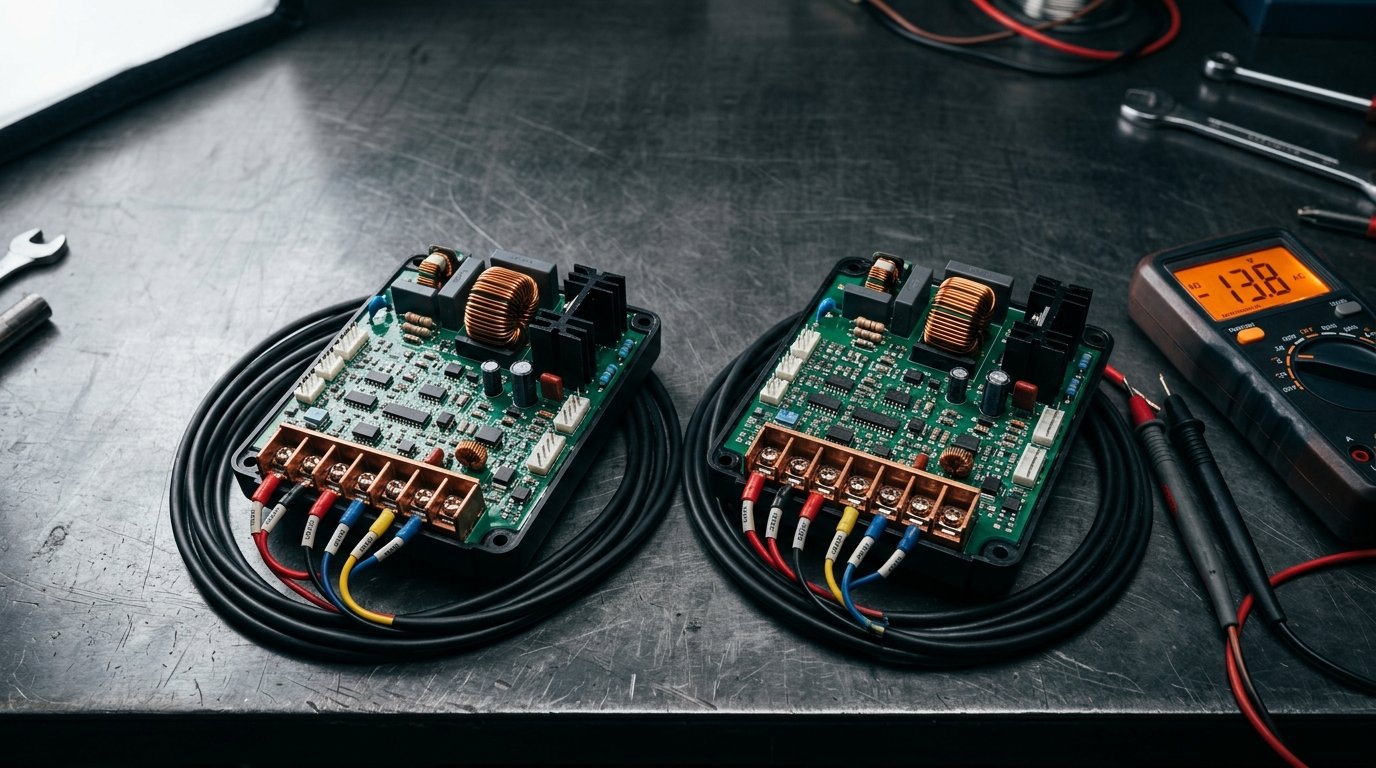



The SS50HW and SS50FW are both 50 amp self-excited AVRs for carbon brush generators, and the single decision point between them is field resistance and field voltage. If your exciter field measures at least 1.4 ohm and needs no more than 90 Vdc, choose the half-wave SS50HW. If it measures at least 2.7 ohm and needs up to 180 Vdc, choose the full-wave SS50FW.
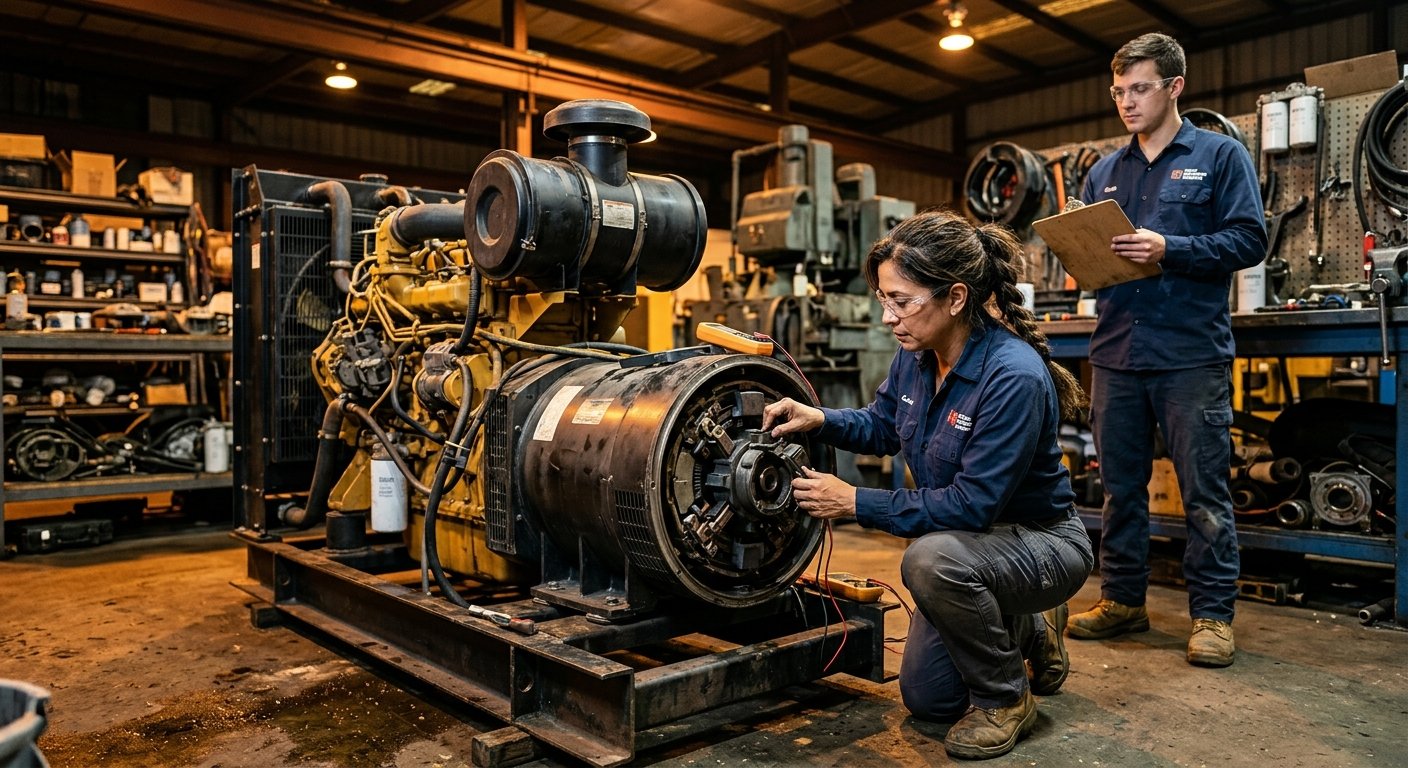
On a carbon brush generator, the AVR controls output voltage by regulating the DC current fed to the exciter field winding through physical carbon brushes. The SS50 is a self-excited design, meaning it draws its power supply from the generator’s own AC output rather than a separate excitation source. It senses the single-phase AC terminal voltage — anywhere in the 170–265 Vac range — compares it to an internal reference, and adjusts field current accordingly to hold output voltage within ±1% under steady load conditions with 4% speed governing.
That tight regulation makes the SS50 a practical replacement for aging brushed-excitation systems on older commercial and marine gensets still running in the field. For more on how AVRs fit into the broader generator control picture, see our overview of automatic voltage regulators.
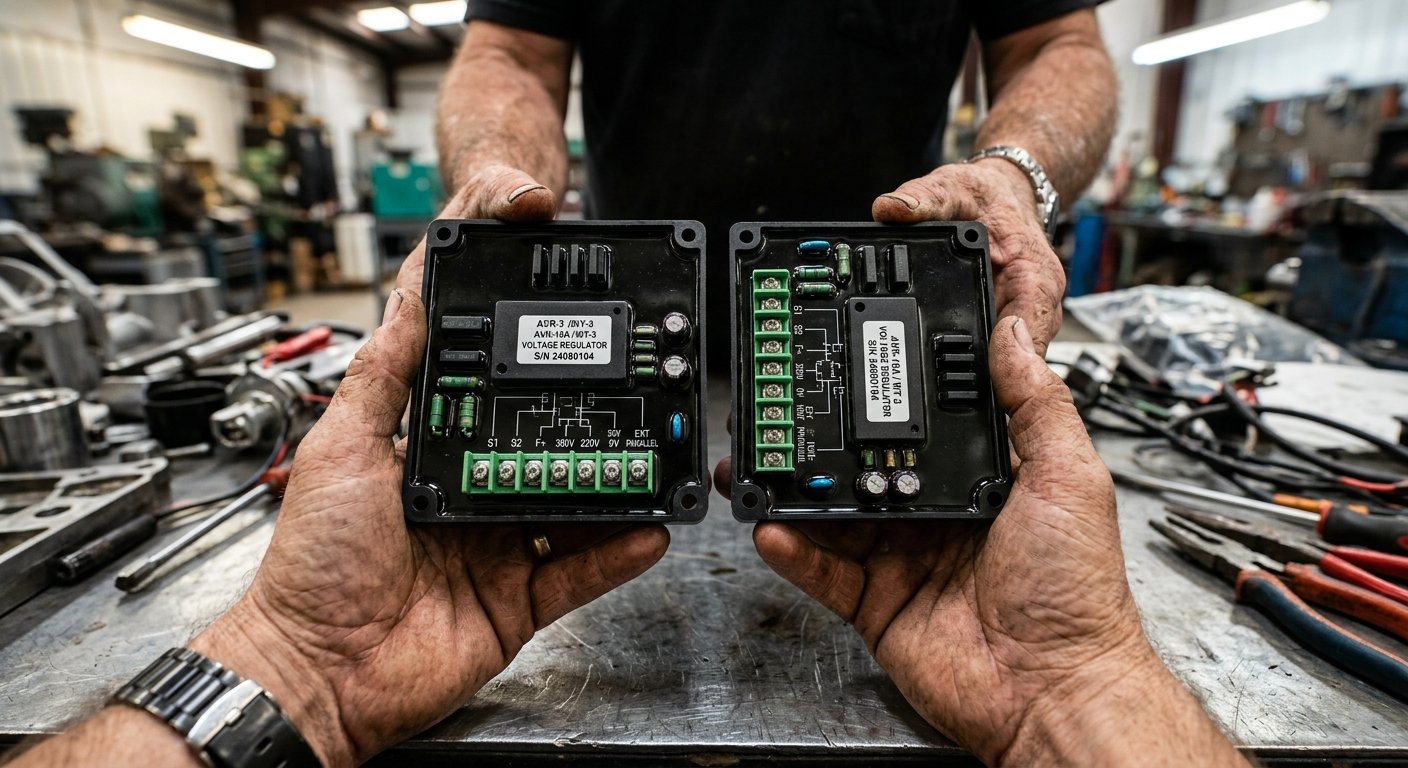
| Specification | SS50HW (Half Wave) | SS50FW (Full Wave) |
|---|---|---|
| Max field voltage output | 90 Vdc | 180 Vdc |
| Min field resistance | 1.4 ohm | 2.7 ohm |
| Current rating (sold as) | 50 A | 50 A |
| Current rating (manual spec table) | 45 A continuous / 60 A for 10 s | 45 A continuous / 60 A for 10 s |
| Voltage sensing range | 170–265 Vac single-phase | 170–265 Vac single-phase |
| Frequency | 50/60 Hz selectable | 50/60 Hz selectable |
| Knee point (50 Hz setting) | 45 Hz preset | 45 Hz preset |
| Knee point (60 Hz setting) | 55 Hz preset | 55 Hz preset |
| External volts adjustment | ±6% | ±6% |
| Voltage regulation | ±1% (with 4% governing) | ±1% (with 4% governing) |
| Cooling | Forced fan | Forced fan |
| Weight | 4.5 kg | 5.2 kg |
| Operating temperature | −40 to +60 °C | −40 to +60 °C |
The SS50 is not equipped with loss-of-sensing protection or over-excitation protection. An additional over-voltage protection device for the load may be required to avoid possible damage to equipment or severe personal injury or death. Consult the full SS50 manual (PDF) and a qualified technician before commissioning.
The terms “half wave” and “full wave” describe how the AVR rectifies AC power before delivering it to the exciter field. A half-wave rectifier conducts on only one half of each AC cycle, producing a lower average DC voltage — hence the SS50HW’s 90 Vdc ceiling. A full-wave rectifier uses both halves of the cycle, roughly doubling the average DC output — hence the SS50FW’s 180 Vdc ceiling.
That difference in rectification topology is directly why the minimum field resistance specifications differ. Higher output voltage with the same field winding would push excessive current through a low-resistance coil. The SS50FW’s higher 2.7 ohm minimum protects the exciter field from overcurrent at its elevated voltage range. The underlying sensing, regulation logic, cooling, and frequency-selection features are otherwise shared between both models.
If you’re comparing AVR types more broadly — for instance, evaluating whether your machine needs an AVR or a transfer switch upgrade — our article on AVR vs transfer switch key differences is a useful reference point before committing to a part.
Measure the exciter field resistance with the generator shut down and the field terminals disconnected. Then check the generator’s data plate or field winding documentation for the nominal field voltage at rated load. Apply this decision rule:
Use a calibrated ohmmeter across the field winding terminals with all connections removed. Record the value in ohms.
Find the rated field voltage on the generator nameplate or winding data sheet. This is the DC voltage needed at full load excitation.
If field resistance is ≥ 1.4 ohm and required field voltage ≤ 90 Vdc, select the SS50HW. If resistance is ≥ 2.7 ohm and field voltage goes up to 180 Vdc, select the SS50FW.
If the nameplate data is worn or missing, contact MTS Power Products with whatever machine data you have. We’ll help you identify the right variant before a part ships.
If you install an SS50 and your field resistance falls below the published minimum for that variant, the AVR will attempt to drive more current through the winding than the power stage is rated to handle. The SS50 manual’s troubleshooting section identifies low field resistance as a direct cause of hunting — the unstable oscillation in output voltage that makes loads flicker and sensitive electronics fault.
The correct fix is to add a series resistor in the field circuit to bring the total resistance up to or above the minimum specification. Do not simply swap to the other SS50 variant hoping it will tolerate the low resistance; the minimum figures are floor values, not preferences.
Low field resistance doesn’t just cause hunting — it’s a documented path to winding failure if left uncorrected.
Both the SS50HW and SS50FW carry the same continuous-duty and transient current ratings from the factory manual. The units are sold and labeled as 50 amp AVRs, but the manual’s specification table is precise: 45 A continuous and 60 A for 10 seconds. Plan your field circuit design around 45 A as the sustained operating limit, not 50 A.
Voltage regulation is rated at better than ±1% with 4% speed governing — a figure that makes these units suitable for generator sets driving sensitive commercial and marine loads. The ±6% external volts adjustment trim allows fine-tuning of the output set-point without internal disassembly, which matters for parallel generator operation and load-sharing applications.
The knee point — the frequency at which the AVR begins reducing field current to prevent core saturation as speed drops — is preset at 45 Hz for 50 Hz machines and 55 Hz for 60 Hz machines. Verify the correct setting is selected on the unit before commissioning. Both variants use forced fan cooling, which accounts for the 4.5 kg (HW) and 5.2 kg (FW) difference in weight and means adequate airflow clearance around the unit is required in the enclosure. Operating temperature is rated at −40 to +60 °C, making both suitable for marine engine rooms and tropical installations alike — an important consideration for the Caribbean and Gulf Coast markets we serve.
For parallel operation requirements, a parallel version of the SS50 is available as an option. Contact us for details if your installation runs multiple gensets in parallel.
The SS50 manual is explicit about a protection gap that installers must address: the SS50 has no internal loss-of-sensing protection and no over-excitation protection. If the sensing voltage signal is lost — due to a broken wire or a fuse failure — the unit has no automatic shutdown. The field can be driven to full output, potentially over-exciting the machine and producing a dangerous over-voltage condition on the load.
The manual states that an additional external over-voltage protection device may be required to protect connected equipment and to prevent severe personal injury or death. This is not a minor advisory. For commercial and marine installations, an external over-voltage relay — coordinated with the generator’s main protection scheme — should be standard practice.
Ensure sensing wiring is fused, routed away from high-voltage cables, and terminated securely. A loose sensing connection on an unprotected AVR is the most common path to an over-voltage event on carbon brush machines.
We carry both the SS50HW and the SS50FW, along with a range of carbon brush AVRs and voltage regulators, and can confirm which SS50 variant suits your machine from the field resistance measurement and generator nameplate data. Our team at MTS Power Products has spent 30 years in Miami building and supporting generator systems — if you’re not certain which half-wave or full-wave unit your carbon brush generator needs, that’s exactly the kind of question we’re here to answer before you order, not after.
Reach our technical support team through the MTS support page or use the contact form below.
Share your field resistance measurement and generator data with our team — we’ll confirm the right SS50 before you order.
The SS50HW is a half-wave rectified AVR with a maximum field voltage output of 90 Vdc and a minimum field resistance of 1.4 ohm. The SS50FW is a full-wave rectified AVR with a maximum output of 180 Vdc and a minimum field resistance of 2.7 ohm. Both figures are measured at 220 Vac input. All other core specifications — sensing range, current rating, regulation accuracy, and cooling — are shared between the two variants.
Measure the exciter field resistance and check the generator’s rated field voltage. If the field resistance is at least 1.4 ohm and the required field voltage is within 90 Vdc, select the SS50HW. If the field resistance is at least 2.7 ohm and field voltage may reach up to 180 Vdc, select the SS50FW. When in doubt, contact MTS Power Products with the machine’s nameplate data before ordering.
Running below the minimum field resistance will cause excessive current draw through the exciter winding and can produce hunting — an unstable oscillation in output voltage. The correct solution is to wire a series resistor into the field circuit to bring total resistance up to or above the published minimum. Do not attempt to compensate by choosing the other SS50 variant; both units have their own minimum floor and neither tolerates sub-minimum resistance safely.
Yes. Both the SS50HW and SS50FW are selectable for 50 Hz or 60 Hz operation. The knee point is preset at 45 Hz for 50 Hz machines and 55 Hz for 60 Hz machines. Confirm the correct frequency is selected on the unit before commissioning the generator.
Both SS50 variants are sold as 50 amp AVRs, but the manual’s specification table states the actual ratings as 45 A continuous and 60 A for 10 seconds. Design your field circuit around 45 A as the sustained limit. Voltage regulation is rated at better than ±1% with 4% speed governing across both units.
MTS Power Products is a Miami-based, manufacturer-direct supplier of generator parts — including AVRs, transfer switches, battery chargers, and governors — serving commercial, marine, and residential backup power needs nationwide. They combine deep technical expertise with personalized service, helping generator technicians, electricians, facility managers, marine operators, and homeowners select the right parts and keep their backup power systems running reliably. Their direct-from-manufacturer model delivers fair pricing and knowledgeable support that big-box distributors cannot match. Visit mtspowerproducts.com →