


A generator that can’t hold steady frequency isn’t just annoying — it’s a liability. Sensitive electronics trip offline, motor loads surge, and in a commercial or hospital setting, that instability can cascade into serious equipment damage. The governor is the component responsible for keeping engine speed — and therefore output frequency — stable under varying loads. Get it wrong, and everything downstream suffers.
If you’re sourcing a replacement governor for generator service, or you’re deciding between generator types for a new installation, understanding the mechanical vs electronic governor distinction is essential. These aren’t interchangeable options. They perform differently, suit different applications, and fail in different ways.
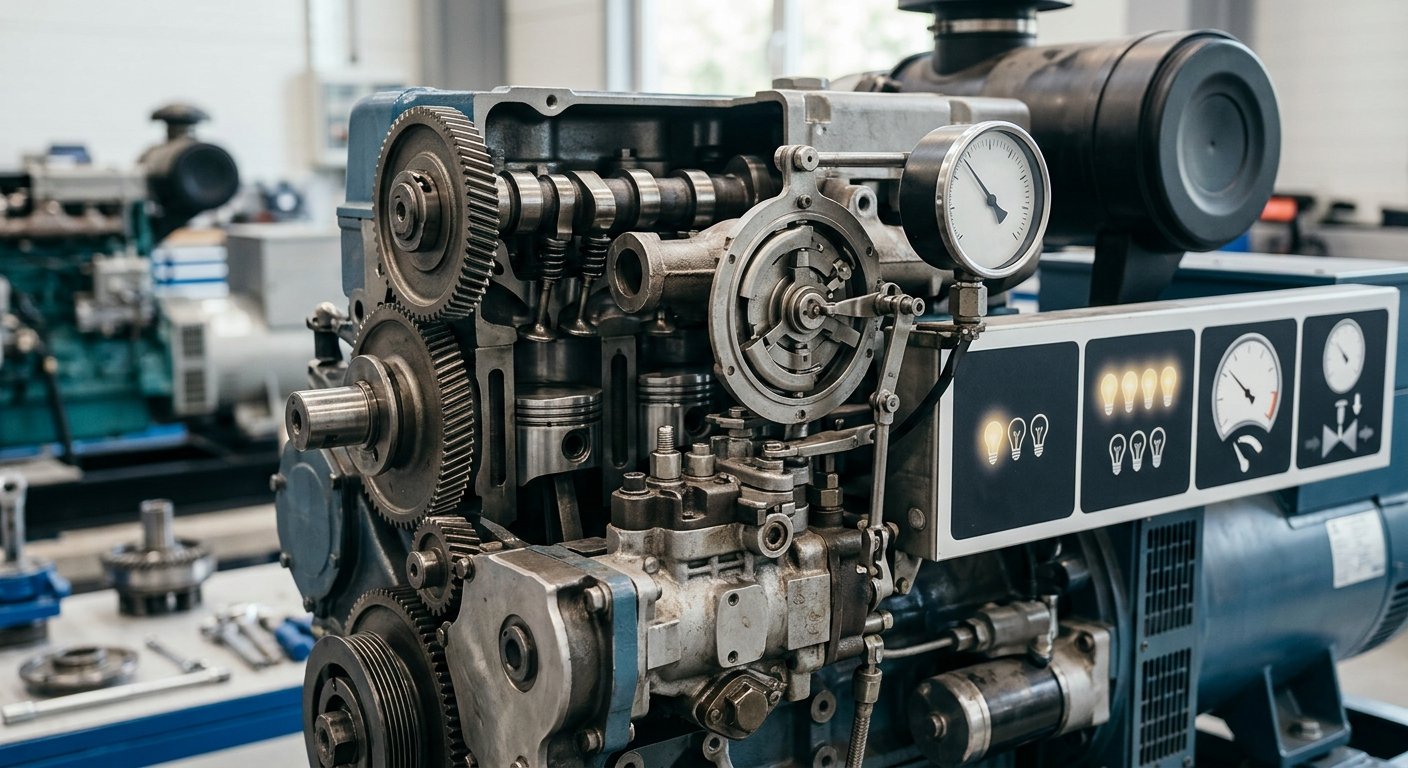
In any generator set, the engine must spin at a constant RPM to produce stable AC frequency — 60 Hz in the US requires 1800 or 3600 RPM depending on the number of poles. When load increases (more equipment draws power), the engine naturally wants to slow down. The governor detects that speed drop and opens the fuel rack wider to compensate. When load drops, it closes the fuel rack. This happens continuously, in real time.
Without a properly functioning governor, frequency fluctuates. A 5% frequency deviation is enough to trip variable-frequency drives and UPS systems. For South Florida facility managers keeping a data center or hospital online during hurricane season, that tolerance window is razor thin.
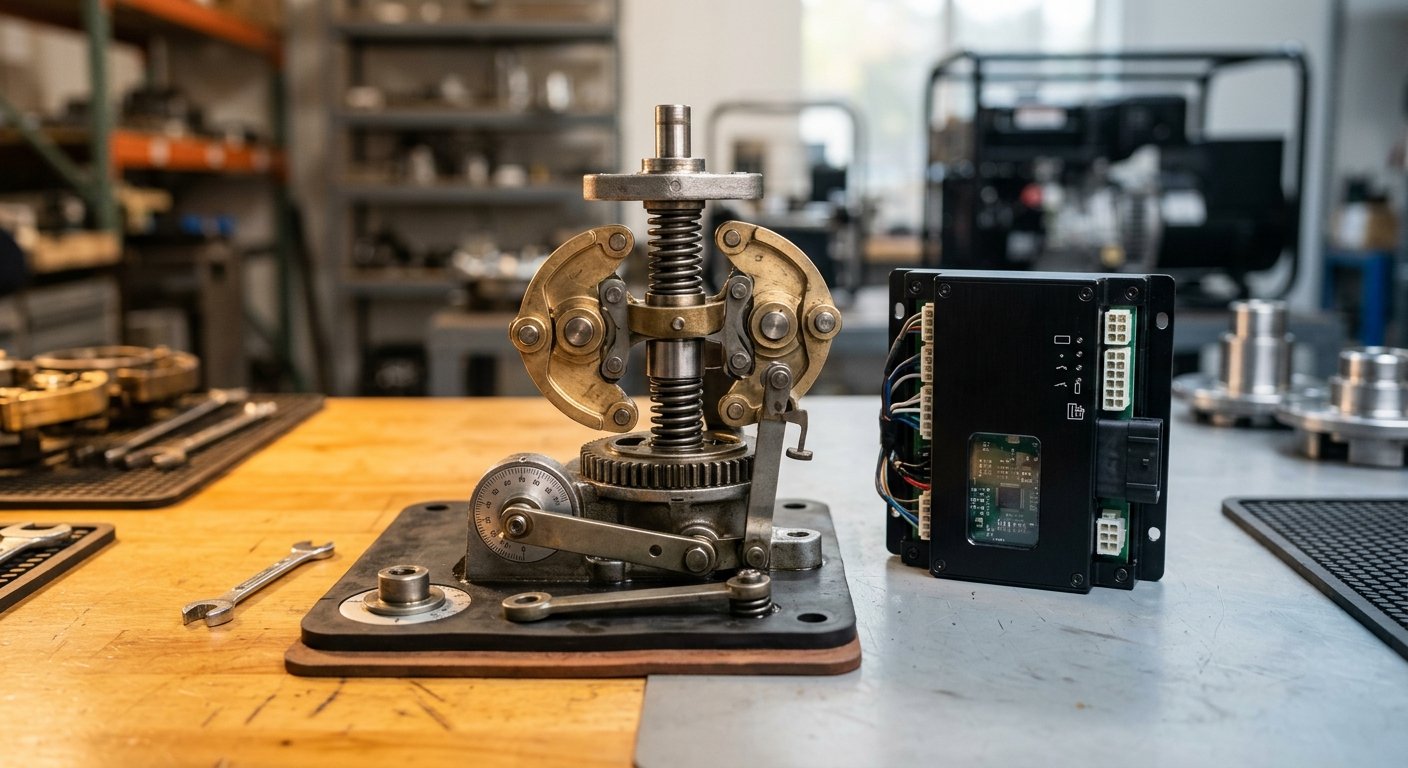
Mechanical governors use physics — specifically centrifugal force — to regulate engine speed. A set of flyweights spins on a shaft driven by the engine. As RPM increases, centrifugal force pushes the flyweights outward, which mechanically moves a fuel control linkage to reduce fuel delivery. As RPM drops, the flyweights retract and more fuel is admitted.
This system is entirely self-contained. No sensors, no ECU, no wiring harness. The feedback loop is purely mechanical.
Electronic governors replace the flyweight mechanism with a speed-sensing circuit — typically a magnetic pickup (MPU) mounted near the engine’s ring gear or flywheel. The MPU generates a frequency signal proportional to engine RPM. An electronic control module (ECU or actuator controller) compares that signal against a programmed setpoint and drives an electronic actuator to adjust fuel delivery.
The feedback loop is electrical, and it’s fast. Response times are measured in single-digit milliseconds, which translates directly into tighter frequency regulation.
For mechanical governors, adjustment typically involves changing spring preload (which sets idle speed and droop), adjusting the speed control lever or screw, and verifying linkage travel. These adjustments are done by hand, confirmed with a frequency meter or tachometer, and locked with jam nuts. A diesel generator Florida technician who has serviced older Cummins or John Deere engines knows this process by feel after enough repetitions.
Electronic governor adjustment happens at the controller — either via trim potentiometers on the actuator driver board or through a laptop interface on modern digital units. Parameters like gain, stability (integral), and droop percentage are tuned in software. Getting the stability setting wrong is the most common cause of governor hunting on electronic systems.
According to PJM Interconnection’s generator performance research, governor response speed and accuracy are critical not just for individual standby units but for grid stability under large frequency disturbances — a fact that underscores why proper governor calibration matters even for facilities not directly connected to utility grid management.
The NFPA 110 Standard for Emergency and Standby Power Systems sets performance requirements — including frequency and voltage regulation bands — that many commercial installations must meet. Electronic governors are typically required to achieve the tighter Class 10 and Class 30 transfer times with acceptable transient performance.
Whether you’re replacing a worn mechanical governor on an aging diesel or sourcing an actuator and MPU for an electronic system, part compatibility is everything. A governor matched to the wrong engine speed range or actuator torque rating will either hunt constantly or fail to control the engine under load. Before ordering, confirm:
At MTS Power Products, we supply governor components direct from the manufacturer, which means the part you receive is built to the same spec as the original — not an approximation. Our Miami-based team fields calls from generator technicians and facility maintenance staff across the US daily, helping them cross-reference part numbers and confirm compatibility before the order ships. Reach us at 305-634-1511 if you’re unsure which governor fits your application.
For gensets where AVR performance is also in question, the governor and automatic voltage regulator work as a system — frequency stability and voltage stability are interdependent. Diagnosing one without checking the other often leads to repeat service calls.
A mechanical governor uses spinning flyweights and physical linkages to regulate engine speed, while an electronic governor uses a magnetic pickup sensor and electronic control module to detect speed changes and adjust fuel delivery. Electronic governors respond faster and hold tighter frequency regulation, but mechanical governors are simpler and easier to service in the field.
In many cases, yes — retrofit kits exist for common engine platforms. However, the engine must have a compatible fuel system actuator interface, and the installation requires recalibration. It’s not a drop-in swap. Consult with a qualified technician and verify compatibility with the engine manufacturer’s documentation before proceeding.
Hunting — the engine oscillating above and below setpoint — is usually a tuning or wear issue. On mechanical governors, worn springs or sticky linkages are common culprits. On electronic governors, the gain or stability setting is typically too aggressive. Start with a linkage inspection and lubrication on mechanical units; on electronic systems, reduce gain incrementally until oscillation stops. If the issue persists, the actuator or MPU may need replacement.
Governor adjustment should be part of every annual PM on a standby generator and any time frequency regulation becomes noticeably unstable. For units in demanding duty cycles — prime power or frequent load shedding — inspect governor components every 500 operating hours. Per U.S. Department of Energy guidelines on generator maintenance, proper speed regulation directly impacts fuel efficiency and emissions compliance.
Yes. Natural gas generators generally require faster governor response because gas engines have less combustion lag buffer than diesel. Electronic governors are strongly preferred for natural gas applications. Diesel gensets can run effectively with either type, depending on load sensitivity requirements and the age of the installation.
Need a governor for your generator? MTS Power Products supplies mechanical and electronic governor components direct from the manufacturer — for diesel and natural gas applications, commercial standby, marine, and fleet gensets across the US. Call our Miami team at 305-634-1511 or visit our online store to find the right part for your engine. If you’re also evaluating your battery charger or transfer switch components, we carry those as well — all manufacturer-direct, with real technical support behind every order.