


Voltage fluctuation is one of the most common — and most misdiagnosed — problems in standby and prime power generators. Lights flickering, sensitive equipment alarming, or a load bank test showing unstable output all point to the same question: what’s causing the generator to produce inconsistent voltage? The answer is almost never just one component, but there’s a logical order to how you find it.
This guide walks through the real diagnostic process — the kind a technician uses on-site, not a guesswork flowchart. Whether you’re chasing a hunting AVR on a commercial standby unit or troubleshooting erratic output on a marine generator, the same fundamentals apply.
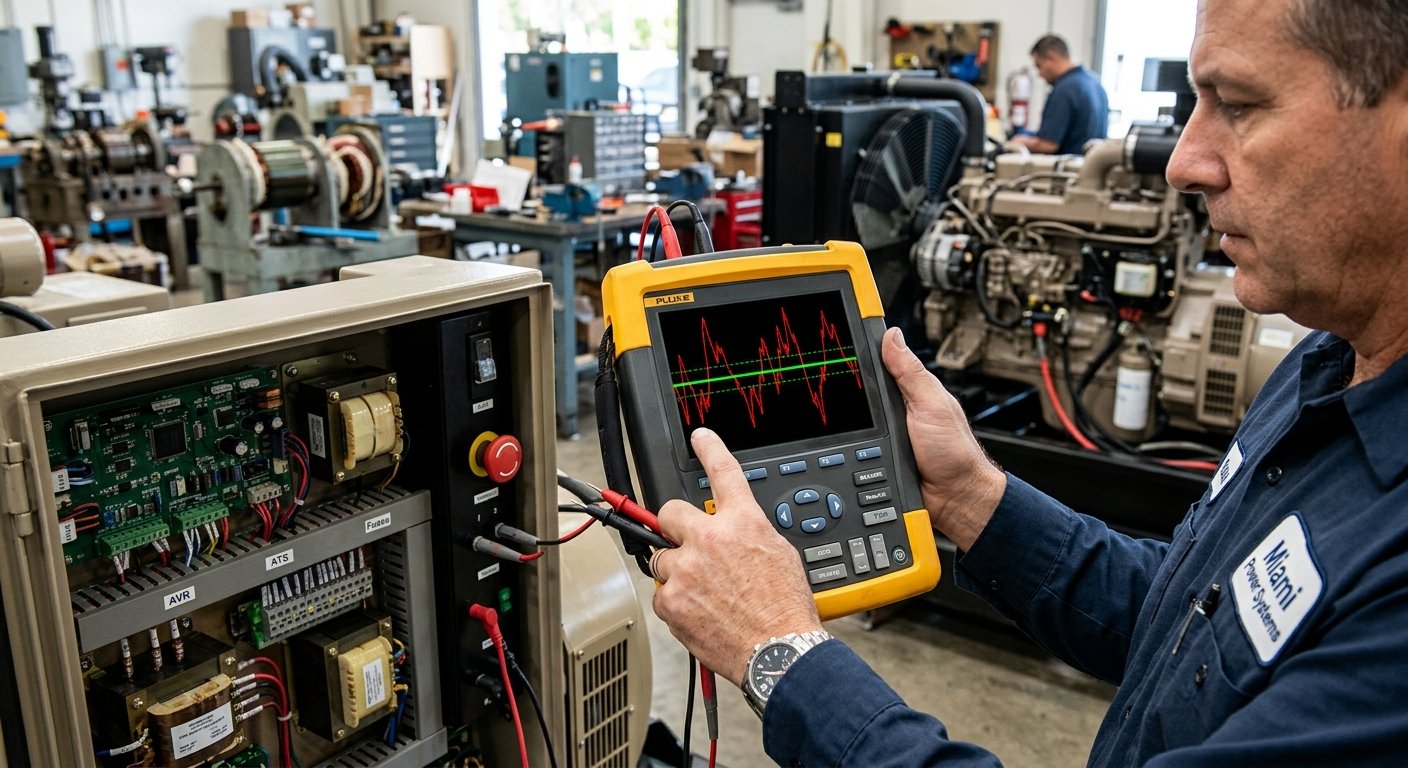
Voltage fluctuation — also called voltage hunting — describes output that swings above or below the rated setpoint rather than holding steady. A properly functioning generator should maintain output within ±2% of rated voltage (typically 120/240V single-phase or 208/480V three-phase) under varying load conditions. Deviations beyond that threshold indicate a control or mechanical problem that needs immediate attention.
Common symptoms include:
Note the difference between hunting (rhythmic oscillation at no-load or light load) and load response failure (voltage sags or spikes when loads connect). They often have different root causes.
Before touching the AVR or governor, rule out the obvious. A surprising number of service calls trace back to simple mechanical or electrical conditions.
An engine running lean or surging mechanically will cause voltage instability that mimics an AVR fault. Check fuel pressure, injector condition, and air filter restriction. A dirty fuel filter on a diesel standby unit can cause RPM variation that the governor can’t correct fast enough, producing voltage swings of 10–15V or more.
Voltage and frequency are directly related in a synchronous generator. If engine speed isn’t holding 60 Hz (3,600 RPM for 2-pole, 1,800 RPM for 4-pole), voltage will drift with it. Use a frequency meter or a quality multimeter with frequency function — don’t rely on the generator’s panel meter alone. According to NEMA generator standards, frequency deviation beyond ±0.5 Hz during steady-state operation signals a governor problem, not an AVR problem.
Loose connections on the generator end terminals, corroded battery terminals affecting the AVR excitation circuit, or damaged sensing wires all introduce instability. Check terminal torque specs. On older units, vibration-loosened terminal connections are a leading cause of intermittent voltage problems that are maddeningly difficult to reproduce on a bench.
The automatic voltage regulator is the electronic brain of your generator’s voltage control system. It monitors output voltage through sensing leads and adjusts excitation current to the field winding to maintain the setpoint. When it malfunctions, voltage control falls apart.
Start with these checks before condemning the unit:
If testing confirms the AVR is faulty, AVR replacement is straightforward on most generator ends — but cross-referencing the correct part number for your specific generator end and engine combination matters. Getting the wrong AVR voltage sensing range or stability characteristic will cause new problems. The team at MTS Power Products helps technicians match AVR specifications to their exact generator configuration — reach them at 305-634-1511 or through the generator parts store.
If the AVR tests healthy but voltage still fluctuates, the generator governor becomes the prime suspect — especially if voltage swings are paired with audible RPM changes.
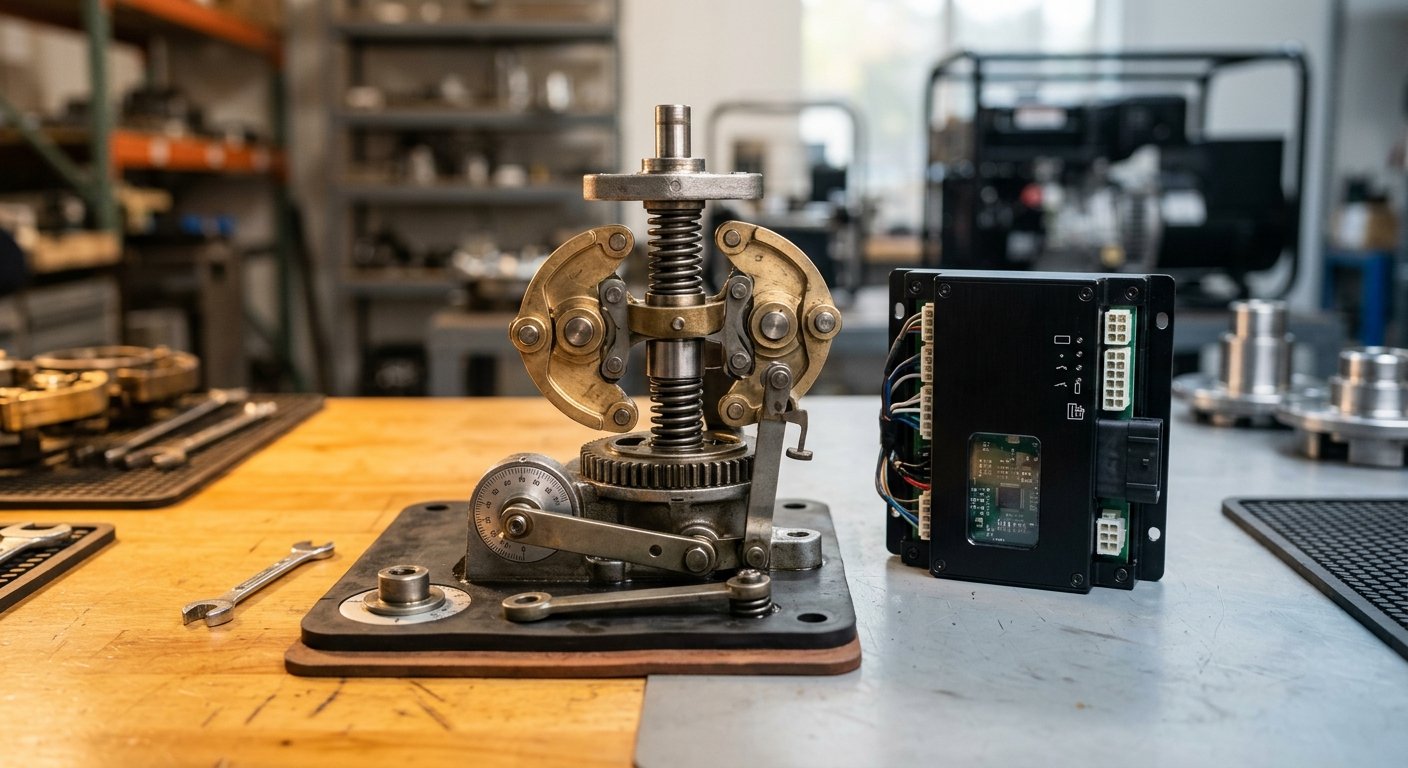
The governor controls engine speed under varying load. A mechanical governor with worn linkages, sticking actuators, or incorrect droop settings will allow RPM to hunt, which drives voltage instability that no AVR can fully compensate. Electronic governors can also fail or drift out of calibration, causing similar symptoms.
Key governor checks:
Hunting that disappears under load but returns at no-load almost always points to governor stability settings, not AVR. Hunting that worsens under load tends to indicate AVR or generator end issues.
The generator end (alternator) itself can produce voltage fluctuation when internal components degrade. Issues to check include:
A rotating diode failure is worth checking before replacing the AVR on any brushless generator. It’s a common misdiagnosis, and the diode assembly is far less expensive than an AVR replacement.
Once you’ve addressed the identified fault, verify repair with a proper load test. Apply load in steps — typically 25%, 50%, 75%, and 100% of rated capacity — and monitor voltage at each step. Per NFPA 110 standards for emergency standby systems, voltage should recover to within ±5% of rated within 10 seconds of a load application step. Tighter recovery specs apply to hospital-grade and critical facility installations.
Document your before-and-after voltage readings. This protects you professionally and gives facility managers the data they need for compliance records.
The most common causes are a failing automatic voltage regulator (AVR), worn or miscalibrated governor, failed rotating diodes in the generator end, or loose sensing connections. Load-induced voltage sag specifically often points to an underpowered excitation system or a faulty AVR that can’t respond fast enough to load transients.
Yes. The governor controls engine RPM, and in a synchronous generator, RPM directly determines output frequency and influences voltage. A hunting or poorly tuned governor will cause both frequency and voltage instability, even if the AVR is functioning correctly. Always check engine speed stability before condemning the AVR.
Key indicators of AVR failure include: voltage that cannot be adjusted via the trim potentiometer, output voltage that collapses under any meaningful load, visible burn damage on the AVR board, or zero DC output to the exciter field despite correct AC sensing input. Confirm with systematic testing before ordering an AVR replacement to avoid misdiagnosis.
You need the generator end make and model, the AVR part number from the existing unit (usually on a label), and confirmation of the sensing voltage range and stability characteristics. A manufacturer-direct parts supplier like MTS Power Products can cross-reference your specifications and confirm compatibility — call 305-634-1511 or use the online parts store to get it right the first time.
Absolutely. Sustained over-voltage accelerates insulation breakdown in motors and transformers. Under-voltage causes motors to draw excess current and overheat. Rapid voltage swings can damage sensitive electronics, VFDs, and UPS systems. Address voltage instability promptly — it’s not a cosmetic issue.
Voltage fluctuation is a solvable problem when you work through it systematically — engine stability, AVR function, governor calibration, and generator end integrity. Skip steps and you’ll replace parts that weren’t the problem.
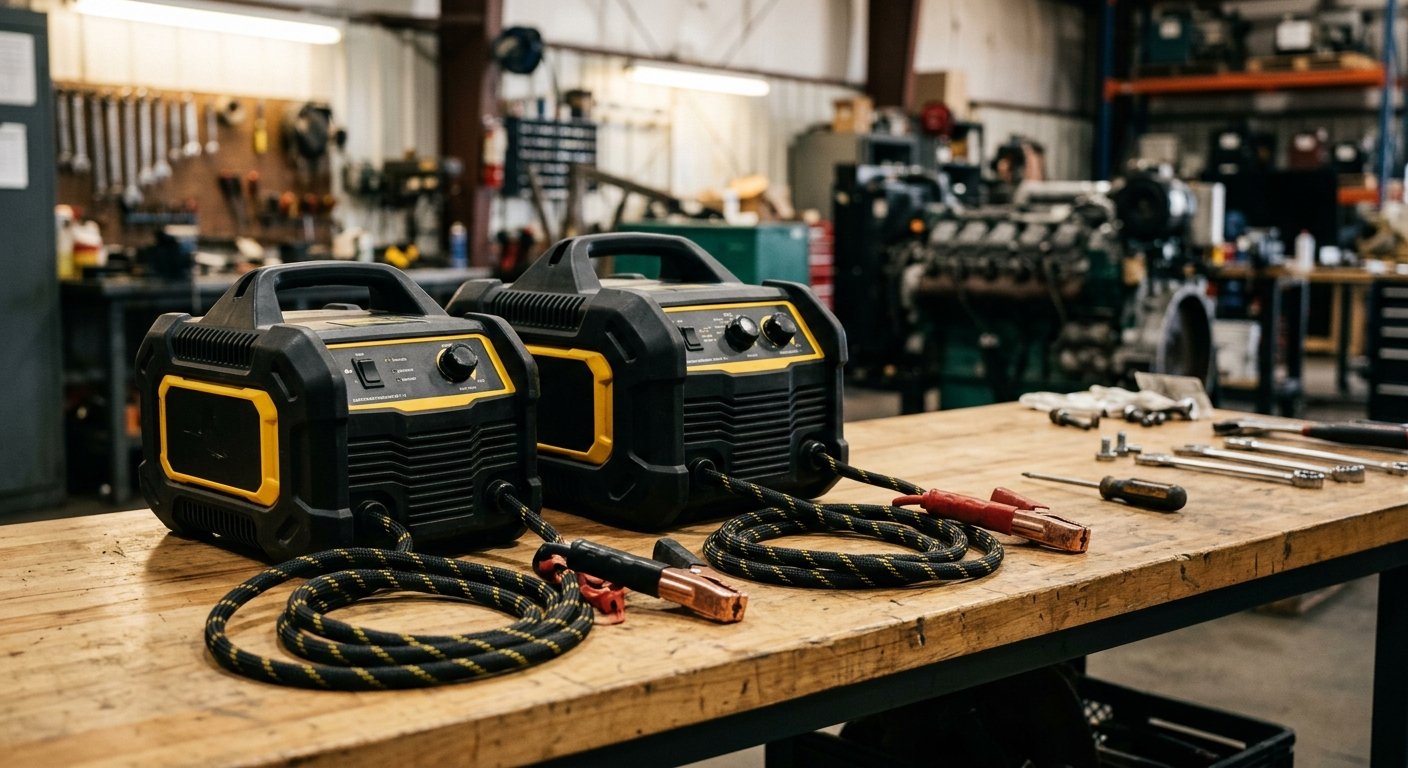
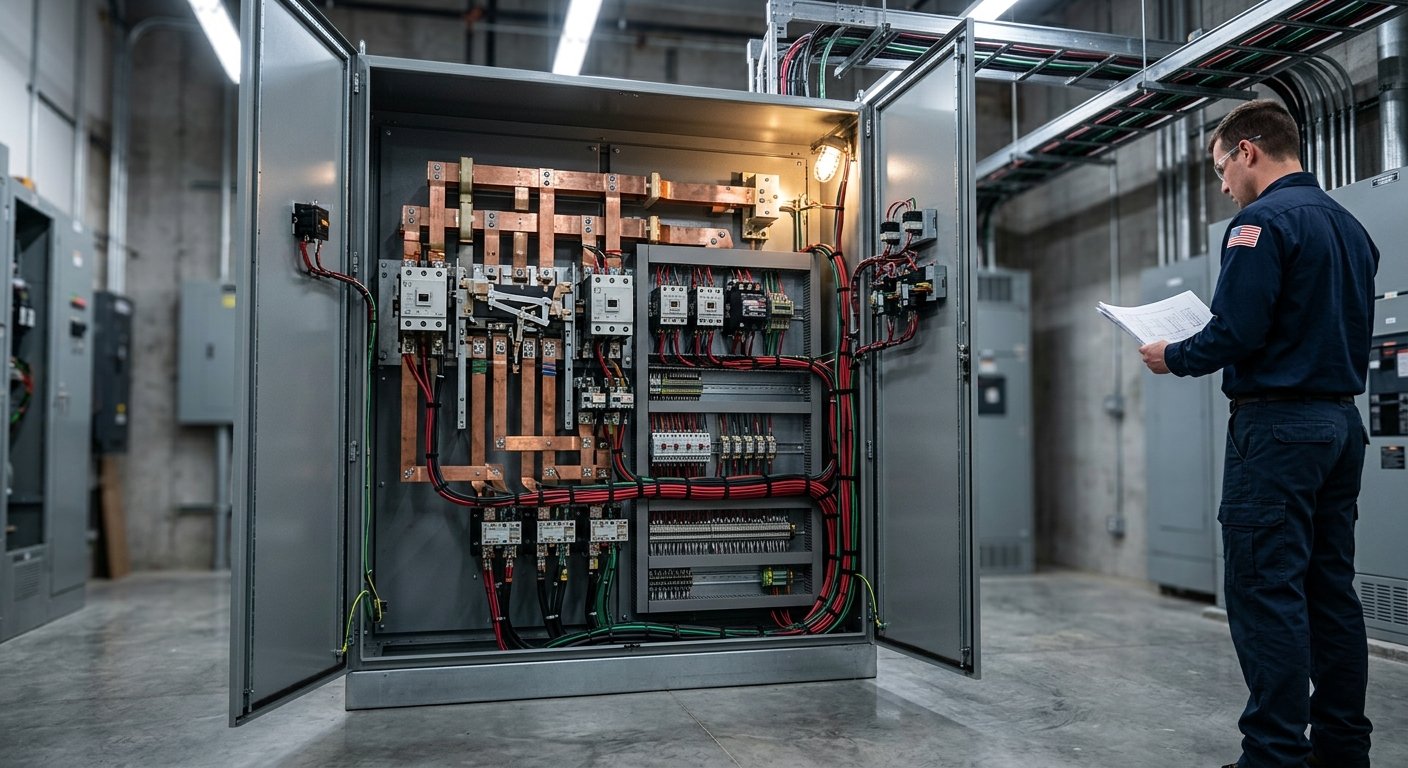
MTS Power Products supplies AVRs, governors, battery chargers, transfer switches, and generator end components direct from manufacturers to technicians and facility teams across the United States. Our Miami-based team knows these systems inside out and can help you identify the correct part for your specific generator — not just the closest match.
Browse our generator parts catalog, explore our AVR selection, or call us directly at 305-634-1511. Get the right part with the right support behind it.