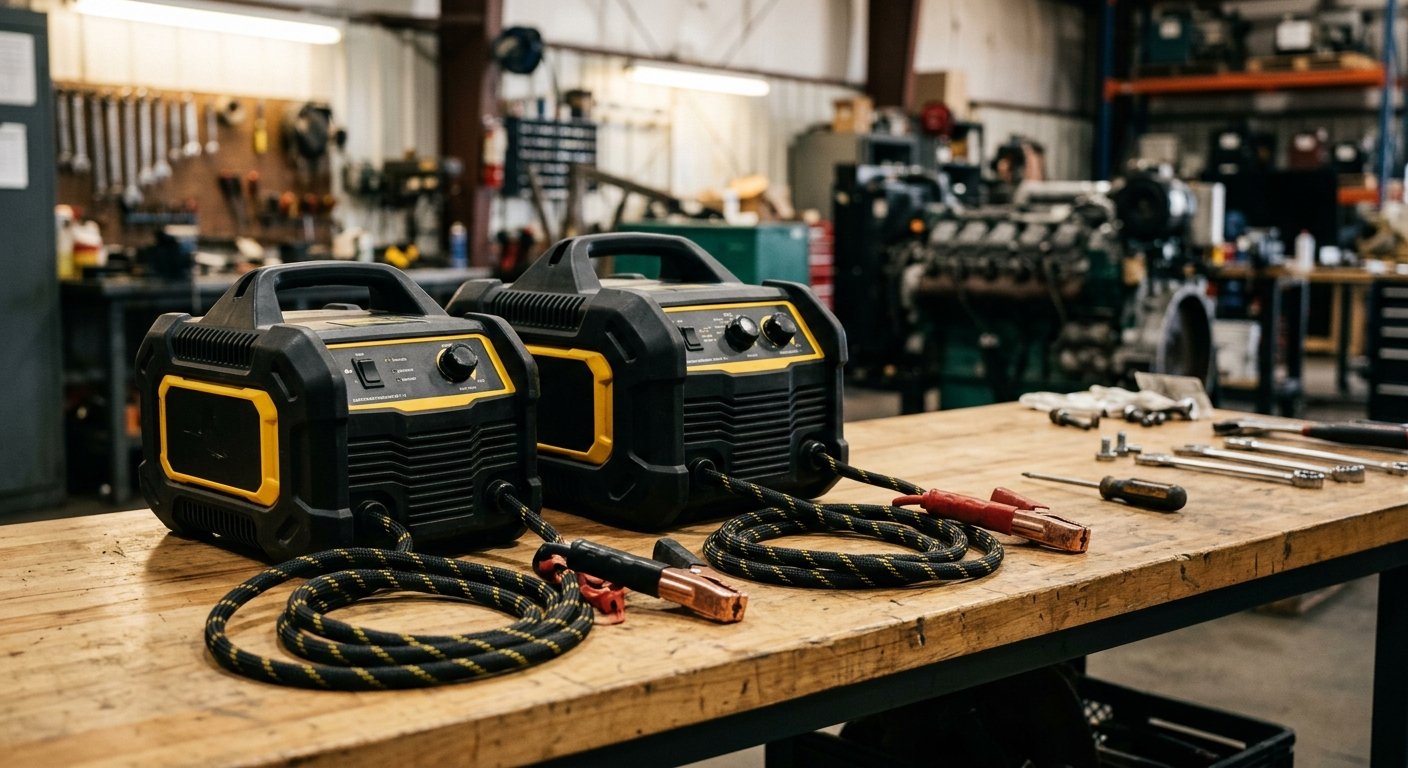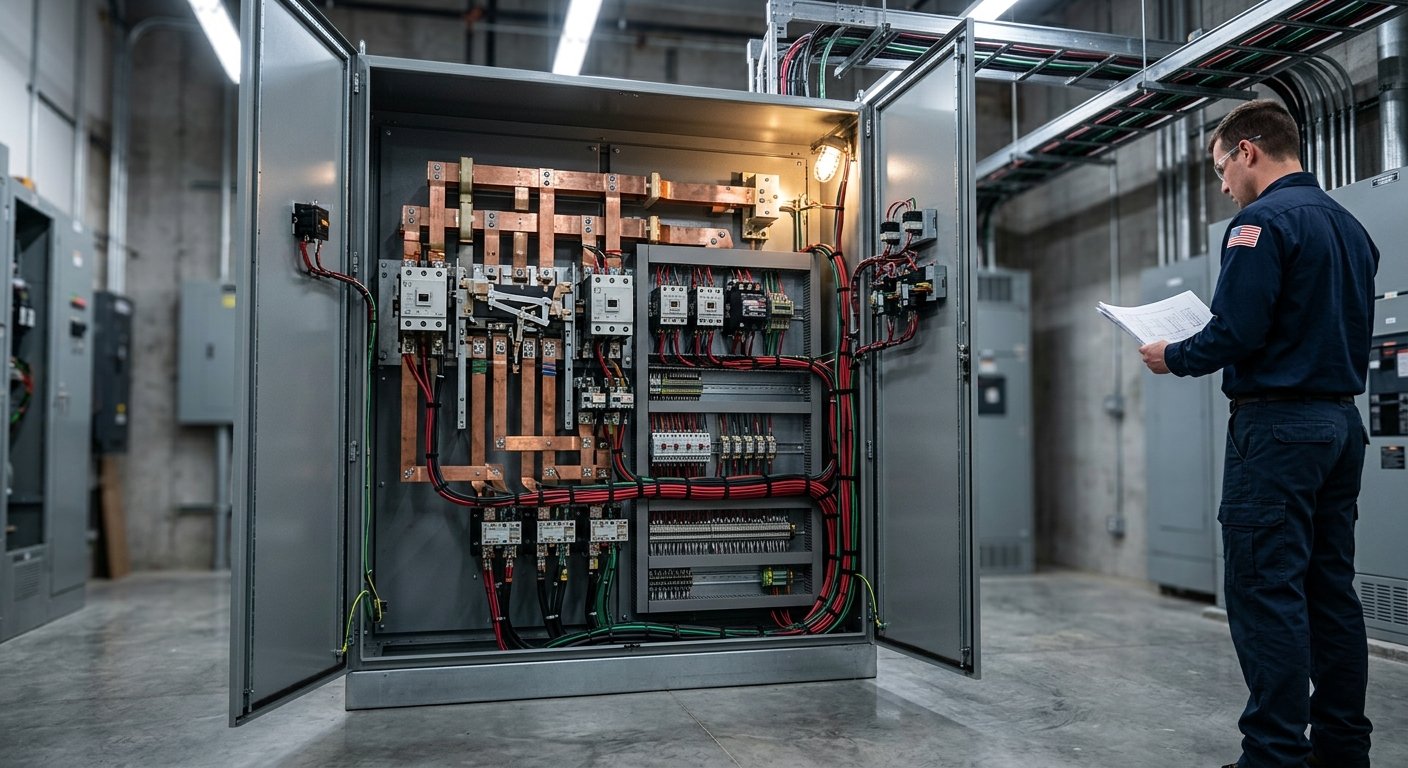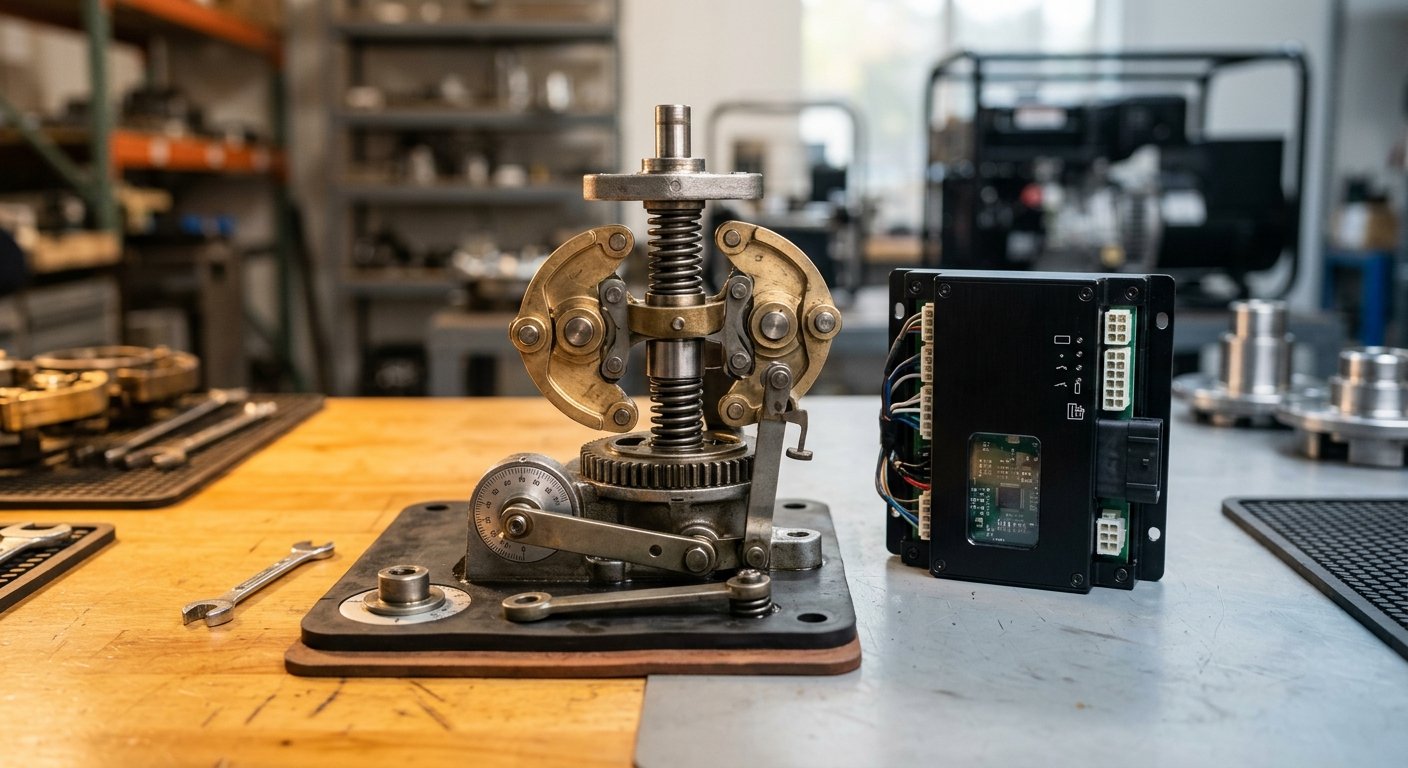



When a generator’s automatic voltage regulator fails or begins to degrade, it announces the problem through a predictable set of electrical symptoms — voltage that swings wildly, lights that flicker or blow, engine hunting under load, and in worst cases, complete loss of output. Recognizing these signals early saves equipment from secondary damage and keeps your backup power system from failing when it matters most.
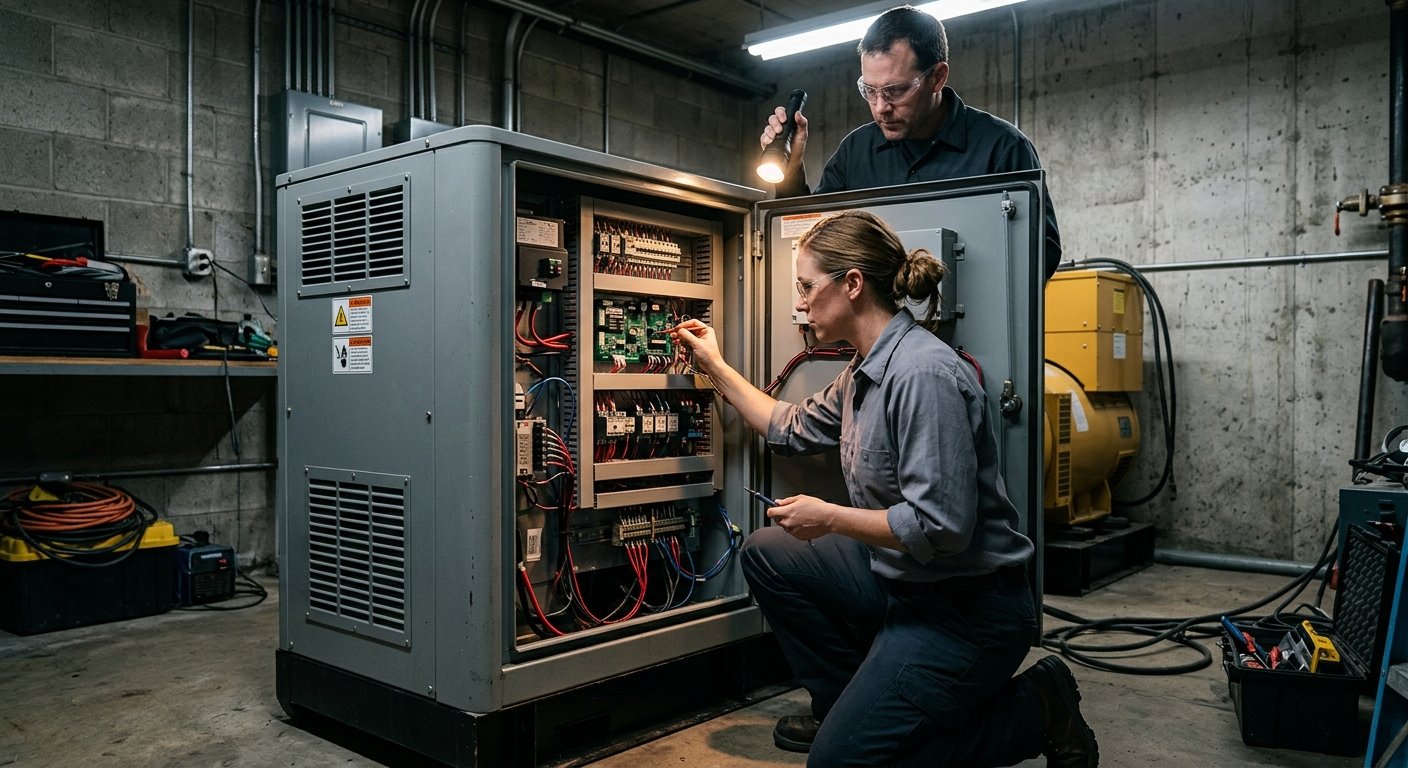
The automatic voltage regulator is a small but mission-critical component. It senses the generator’s AC output voltage, compares it to a reference set point, and continuously adjusts the DC excitation current feeding the rotor field winding. That feedback loop — happening dozens of times per second — is what keeps your output steady at 120/240V or 480V regardless of load swings.
When that loop breaks down, even partially, the alternator can no longer self-correct. The result is not a clean shutdown; it’s a generator that keeps running while quietly damaging everything connected to it. That’s the detail technicians and facility managers need to internalize: a faulty AVR rarely trips a breaker. It just produces bad power.
A generator producing over-voltage for even a few minutes can permanently damage motor windings, variable-frequency drives, sensitive building controls, and UPS systems. If output voltage reads more than 5–10% above nameplate, shut the load down immediately and diagnose before reconnecting.
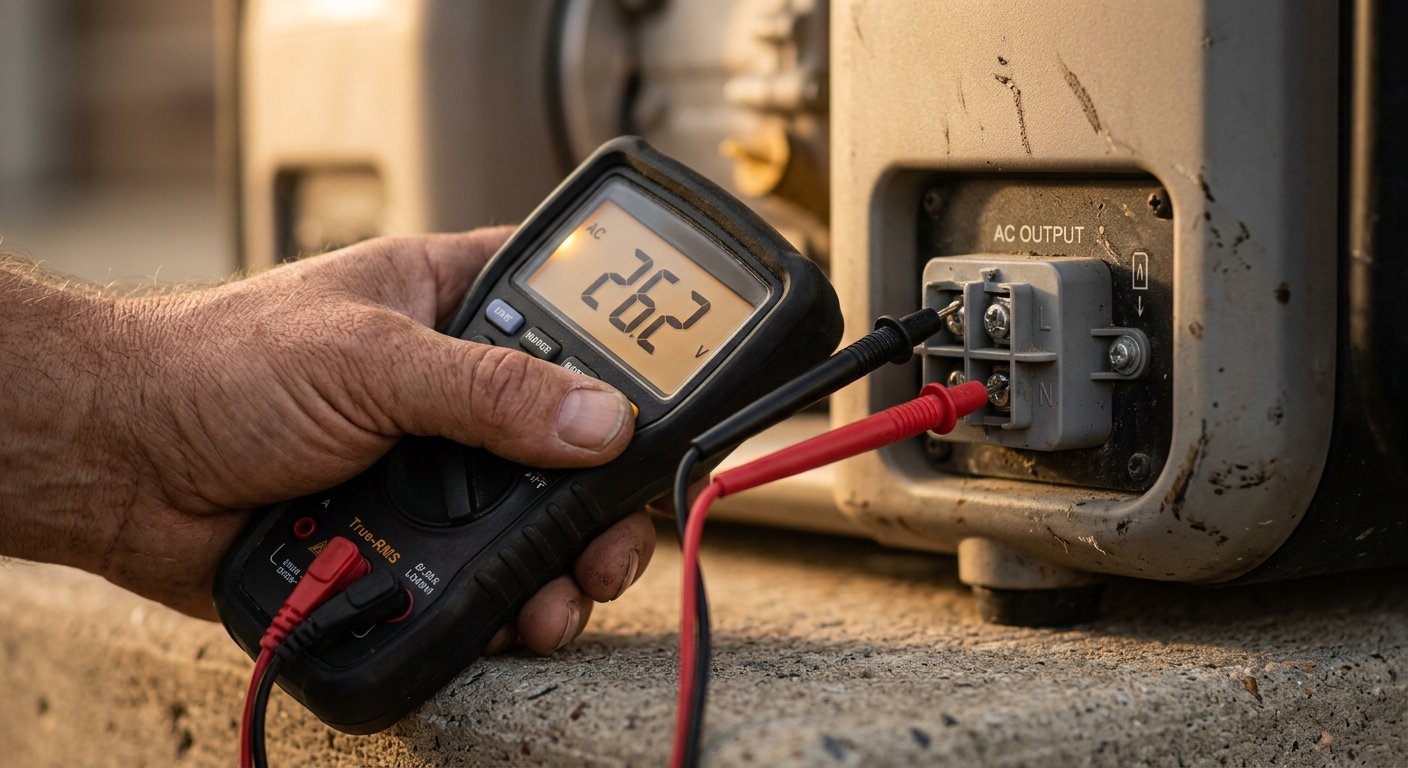
Measure AC output voltage at the generator terminals with a true-RMS digital multimeter while the unit is running under its typical load. A healthy unit holds within roughly ±2% of its rated output across the load range. If you’re reading 260V on a 240V nominal machine, or watching the meter needle drift up and down without a steady load change driving it, the AVR is the primary suspect. Low voltage — sometimes accompanied by a dim or brownout condition — often points to an AVR that has lost excitation capacity or has a failed sensing circuit.
Hunting — the rhythmic surge-and-dip in engine speed you hear as an alternating whine — is frequently blamed on the governor. But the AVR and governor are tightly coupled. If the AVR is sending erratic excitation signals, the load on the engine changes in pulses, and the governor responds by hunting for a speed it can never quite settle on. Before you replace a governor, verify AVR output and excitation voltage. The U.S. Department of Energy’s Operations and Maintenance Best Practices Guide identifies voltage regulation instability as a leading contributor to generator set mechanical fatigue — including governor wear.
A generator that cranks, runs, and produces zero or near-zero AC output has almost certainly lost residual magnetism in the rotor, suffered a shorted AVR, or lost the excitation circuit entirely. The AVR for generator diagnosis here involves checking whether the main circuit breaker has tripped, then measuring DC output from the AVR to the excitation winding terminals. No DC signal from a powered AVR means the regulator has failed. Flashing the field with a 12V battery source (a standard field-flash procedure) can temporarily confirm whether the alternator itself is healthy — if output comes up during a flash, the AVR is the culprit.
This is the symptom homeowners and facility staff notice first. When load steps on or off — an HVAC compressor kicks in, a motor starts — a healthy AVR compensates within milliseconds. A degrading regulator lags behind or overcorrects, producing visible voltage sags or spikes that show up as lighting anomalies. In a commercial setting, this symptom is especially damaging because it signals that VFDs, PLCs, and server equipment are absorbing the same voltage transients that are making your lights flicker.
An over-exciting AVR — one stuck sending too much current to the rotor field — generates heat in the rotor winding. Extended over-excitation will eventually burn the field winding insulation. If you notice a hot electrical smell, winding discoloration, or an alternator that runs hot to the touch in cooler ambient conditions, check field current with a clamp meter. Normal field current is specified on your alternator’s nameplate or service manual; a reading significantly above spec with no large reactive load attached points directly to a runaway AVR.
Always record your baseline voltage readings during a scheduled monthly exercise run, not just when there’s a problem. Trending data over time reveals AVR degradation weeks before it causes a fault — especially important for marine gensets and critical-facility standby units that sit idle between tests.

Use a true-RMS multimeter at the generator terminals. Compare to nameplate voltage under no load and rated load. Anything more than ±5% from nominal is out of spec and warrants deeper investigation.
Locate the AVR’s F+ and F- terminals (or equivalent per your unit’s wiring diagram). DC voltage there should fall within the range stated in the alternator service manual. Zero volts or rail-high voltage confirms AVR failure.
AVR sensing circuits run on low-voltage AC taps. A broken, corroded, or miswired sensing lead produces the same symptoms as a failed AVR. Verify all connections are clean and secure before condemning the unit.
Most AVRs have an onboard trim pot for fine voltage adjustment. If the pot has drifted or corroded open, output voltage will be unstable or clamped at an extreme. Reseat the pot and retest before ordering a replacement.
When you’ve confirmed the AVR is the fault, match the replacement to the alternator manufacturer’s specification — including sensing voltage range, excitation current capacity, and form factor. After installation, check output voltage under no-load and full-load conditions to confirm regulation is restored.
Ordering the wrong AVR is the most common and costly mistake in generator AVR troubleshooting. Two units that look identical can have different excitation current ratings, different sensing voltage ranges, or different stability characteristics that make one incompatible with your alternator brand. Always cross-reference the part number from the alternator nameplate or the original AVR label — not just the generator set model number.
The North American Electric Reliability Corporation (NERC) maintains reliability standards that apply to standby power systems at critical infrastructure sites; under those frameworks, using non-specified replacement components can void compliance status. For commercial and industrial facilities, this is worth noting during procurement.
At MTS Power Products, we supply AVRs direct from manufacturers, which means the part you receive matches the specification sheet — not a generic approximation. Whether you’re maintaining a Stamford, Leroy Somer, Mecc Alte, or Marathon alternator, the right starting point is verifying the original part number. Our team in Miami can help you cross-reference and confirm compatibility before you order. Browse our automatic voltage regulators to see what’s available, or reach out directly with your alternator model and original AVR part number.
A generator that keeps running while producing bad voltage is more dangerous than one that won’t start — because it looks like it’s working.
Repeated AVR failures — two or more units burning out within a short service window — are almost never about the AVR itself. Investigate upstream: excessive load-side harmonics from VFDs or non-linear loads, an undersized generator being run at or beyond rated kVA, poor cooling that keeps the alternator compartment above thermal limits, or wiring faults introducing voltage spikes back into the sensing circuit. The NFPA 110 standard for emergency and standby power systems establishes maintenance and testing requirements that, when followed, surface these root causes before they become costly failures.
If your facility’s standby system needs a broader evaluation — transfer switches, governors, battery chargers, or a look at the whole parts picture — MTS carries the full complement. See our generator parts catalog and our transfer switches for the components most commonly involved in system-level voltage and transfer faults.
The clearest indicators are AC output voltage that reads high, low, or drifts without load changes; visible flickering or dimming of connected lights; engine hunting or surging under steady load; and in severe cases, zero output voltage with the engine running normally. Any of these symptoms warrants immediate multimeter testing before running loads.
Yes, and quickly. An over-voltage condition from a runaway AVR can burn motor windings, damage variable-frequency drives, destroy UPS systems, and fry sensitive electronic controls within minutes. Always disconnect critical loads when you suspect AVR trouble and restore them only after confirming stable, in-spec output voltage.
Measure DC excitation output from the AVR to the field terminals while the unit hunts. If that signal is fluctuating or erratic, the AVR is driving the hunting — not the governor. A stable DC excitation reading during hunting shifts suspicion to the governor or fuel system. Both components interact, so test both before replacing either.
Yes, for reliable operation. The replacement must match the original’s excitation current rating, sensing voltage input range, and stability characteristics for your specific alternator. A generic AVR that appears physically identical can produce the same fault symptoms it was meant to solve. Always verify using the alternator nameplate and original AVR part number.
A visual inspection and output voltage verification should be part of every monthly exercise run. A more detailed check — measuring excitation voltage and inspecting terminal connections — is appropriate at the annual service interval or any time the unit shows voltage instability. Trending your readings over time is the most effective early-warning strategy available.
Tell our Miami team your alternator model and original part number; we’ll confirm compatibility and get you pointed to the correct manufacturer-direct replacement.
MTS Power Products is a Miami-based, manufacturer-direct supplier of generator parts — including AVRs, transfer switches, battery chargers, and governors — serving commercial, marine, and residential backup power needs nationwide. They combine deep technical expertise with personalized service, helping generator technicians, electricians, facility managers, marine operators, and homeowners select the right parts and keep their backup power systems running reliably. Their direct-from-manufacturer model delivers fair pricing and knowledgeable support that big-box distributors cannot match. Visit mtspowerproducts.com →