Why Your Business Needs a Commercial Standby Generator
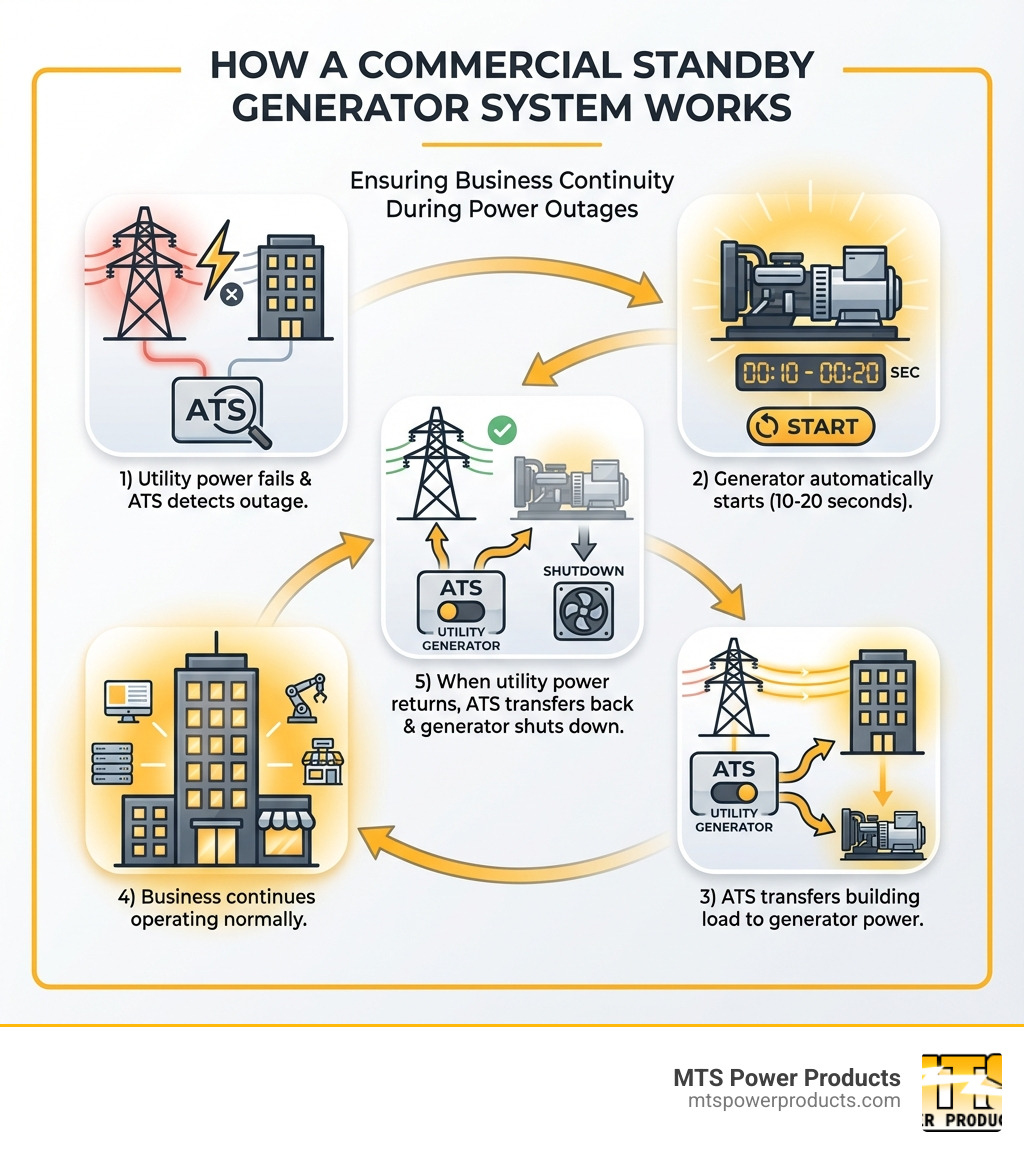
A commercial standby generator is a permanently installed backup power system that automatically detects power outages and restores electricity to your business within seconds. Unlike portable generators, these units are connected directly to your facility’s electrical system through an Automatic Transfer Switch (ATS) and run on diesel, natural gas, or propane.
Key Facts About Commercial Standby Generators:
- Automatic Operation – Detects outages and powers on within 10-20 seconds without human intervention
- Permanent Installation – Mounted outdoors on a concrete pad near your building
- Fuel Options – Runs on natural gas, propane (LP), or diesel fuel
- Power Range – Available from 22kW to 200kW+ for different business sizes
- 24/7 Protection – Operates day or night, regardless of weather conditions
Power interruptions cost businesses far more than just inconvenience. They mean lost revenue, disrupted mission-critical tasks, and potential harm to your brand’s reputation. In high-demand industries like manufacturing, data centers, healthcare facilities, and retail operations, reliable power isn’t optional—it’s critical.
For over 50 years, companies like Generac have focused exclusively on standby power solutions, developing systems that protect businesses from the damaging effects of outages. Whether you’re running essential equipment in a manufacturing plant or maintaining inventory in cold storage, a commercial backup generator kicks in within seconds of detecting a power loss, keeping your operations running smoothly.
The investment in a commercial standby generator goes beyond just buying equipment. It’s about ensuring business continuity, protecting your competitive advantage, and safeguarding your bottom line against the unpredictable nature of the power grid.
Simple guide to commercial standby generator terms:
The Business Case: Why Backup Power is a Critical Investment
Imagine the lights going out in your Miami business. For many, this means a halt in production, lost data, or spoiled goods. This isn’t just an inconvenience; it’s a direct hit to your revenue and reputation. Power interruptions cause lost revenue and disrupt critical tasks, making a commercial standby generator a critical investment, not a luxury.
A reliable backup power system ensures your operations continue seamlessly, protecting against unexpected outages. It’s about maintaining business continuity, protecting data, and ensuring operational security when the grid fails. In many industries, reliable power is essential for securing your future and gaining a competitive edge.

Key Benefits for Your Operation
Investing in a commercial standby generator offers benefits far beyond simply keeping the lights on.
- Uninterrupted Operations: The most direct benefit is continuous power for your essential systems. This prevents downtime, lost productivity, and missed deadlines for any business, from data centers to retail stores.
- Customer Trust: Staying operational during an outage shows reliability and professionalism, reinforcing customer trust. A Miami grocery store that stays open during a hurricane, for example, builds immense community goodwill.
- Employee Safety: A backup generator maintains lighting, HVAC, and security systems, ensuring safe working conditions for your employees during an outage.
- Inventory Protection: A generator protects temperature-sensitive inventory, like perishable goods in restaurants, by maintaining refrigeration and preventing significant financial loss.
- Regulatory Compliance: A commercial standby generator helps you meet strict regulatory requirements for backup power in industries like healthcare or public safety.
- Peace of Mind: Knowing your business is protected from power disruptions provides invaluable peace of mind, letting you focus on growth instead of the next blackout.
Calculating the Return on Investment (ROI)
While the initial cost of a commercial standby generator is substantial, the ROI is compelling when you consider the cost of downtime.
Think about what a power outage means for your business:
- Lost Sales: Every minute your point-of-sale systems are down or your doors are closed is lost revenue.
- Productivity Loss: Idle employees, halted machinery, and stopped data entry all contribute to lost productivity.
- Data Recovery Costs: A sudden power loss can corrupt data, leading to expensive recovery efforts.
- Reputational Damage: Repeated outages can drive customers to more reliable competitors.
A generator can pay for itself by preventing the losses from just one or two major outages. It also provides a competitive advantage, allowing you to operate when competitors can’t. It’s an investment in resilience that ensures your business can weather any storm.
Selecting Your Commercial Standby Generator: A Buyer’s Guide
Choosing the right commercial standby generator is a crucial decision. It’s not a one-size-fits-all solution; the ideal generator depends on your specific power requirements, operational needs, and budget. We’re here to guide this process, ensuring you make an informed choice that will serve your business reliably. Key considerations include understanding your power needs, assessing fuel types, and evaluating modern generator features.
Sizing Your Generator: Power Needs Assessment
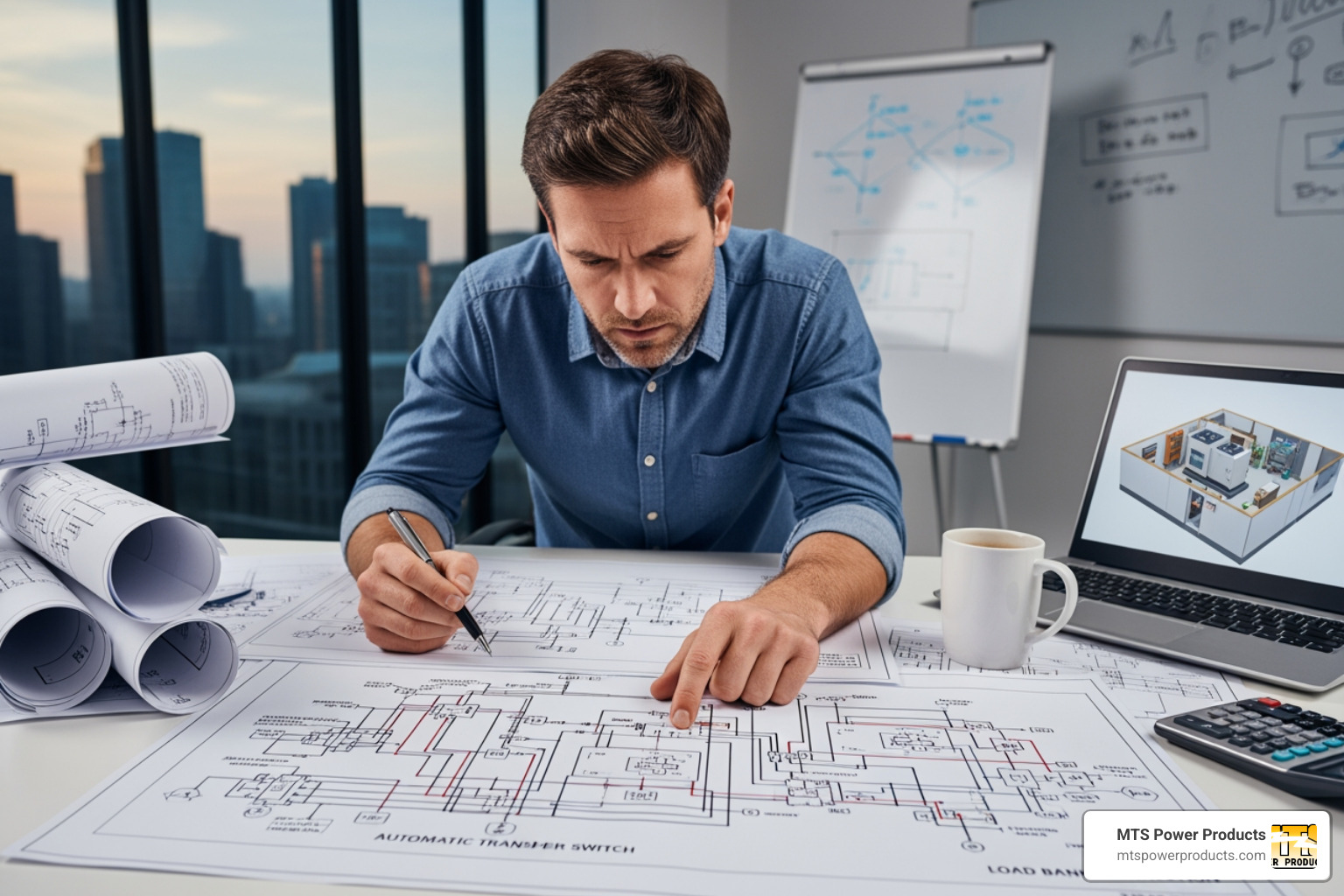
The most critical step is accurately sizing your generator. A detailed power needs assessment ensures the unit can handle your electrical load, avoiding the problems of undersized or oversized systems.
Here’s what we look at:
- Kilowatt (kW) Rating: Generators are rated in kilowatts (kW). You’ll need to calculate the total kW required to power all essential equipment during an outage.
- Essential vs. Non-Essential Loads: We help you differentiate between what must run (e.g., servers, refrigeration, critical lighting) and what can be temporarily shut down to define the baseline power requirement.
- Starting Wattage vs. Running Wattage: Many appliances require a surge of power (starting wattage) to turn on, which is much higher than their continuous running wattage. Your generator must handle these starting loads.
- Future Growth Considerations: It’s wise to factor in a buffer for future power demands to avoid needing an upgrade too soon.
- Professional Load Analysis: We highly recommend a professional load analysis. Our experts can carefully assess your facility’s electrical demands, providing precise calculations and recommendations for the optimal generator size. This prevents costly mistakes and ensures your generator performs exactly as needed.
Fueling Your Power: Diesel vs. Natural Gas vs. Propane
Your choice of fuel influences operational costs, maintenance, and environmental compliance. Each option—diesel, natural gas, and propane (LP)—has pros and cons.
| Fuel Type |
Availability |
Storage |
Cost |
Maintenance |
Emissions |
| Diesel |
Readily available |
On-site tank required |
Varies, can be volatile |
Higher, requires fuel treatment |
Higher NOx and particulate matter |
| Natural Gas |
Utility line dependent |
No on-site storage needed |
Stable, generally lower |
Lower, cleaner burn |
Lower, cleaner burn |
| Propane (LP) |
Delivered, on-site tank |
On-site tank required |
Varies, can be higher |
Lower, cleaner burn |
Lower, cleaner burn |
- Diesel Generators: Robust and reliable, diesel generators are favored for larger applications due to their power density. They require on-site fuel storage, which needs maintenance and refilling—a key consideration in hurricane-prone Miami. While powerful, they have higher emissions, and the fuel can degrade over time.
- Natural Gas Generators: For businesses with a utility line, natural gas generators are a convenient, cost-effective solution. They offer a continuous fuel supply with no on-site storage, meaning virtually unlimited run-time during outages. They burn cleaner, reducing maintenance and emissions, making them a popular choice in Miami.
- Propane (LP) Generators: Propane generators burn cleaner than diesel, reducing emissions and maintenance. They require on-site storage tanks that need refilling. Though the fuel is stable, tanks can be bulky, and costs may be higher than natural gas. It’s an excellent option where natural gas is unavailable.
When considering fuel type, we look at your Miami, FL location, utility access, local regulations, and operational needs to recommend the best solution for your commercial standby generator.
Key Features of a Modern Commercial Standby Generator
Modern commercial standby generators come with advanced features for improved reliability, convenience, and efficiency.
- Automatic Transfer Switch (ATS): The ATS is the system’s brain. It monitors utility power, automatically starts the generator during an outage, and seamlessly transfers the electrical load. When power returns, it reverses the process, all within seconds and without manual intervention.
- Remote Monitoring: Imagine checking your generator’s status from your smartphone or PC. Features like WiFi and cellular monitoring (e.g., Generac’s Mobile Link™) allow you to receive real-time alerts and monitor performance. This improves value by providing peace of mind and enabling proactive maintenance. We’re here to answer all your questions.
- Sound-Attenuated Enclosures: Modern generators feature sound-attenuated enclosures to significantly reduce noise. This makes them compliant with local noise ordinances in Miami and more neighbor-friendly.
- Weather-Protective Housing: Durable, weather-protective housing is crucial in Florida’s climate. These enclosures, often powder-coated for corrosion resistance, protect internal components from rain, humidity, and hurricane-force winds.
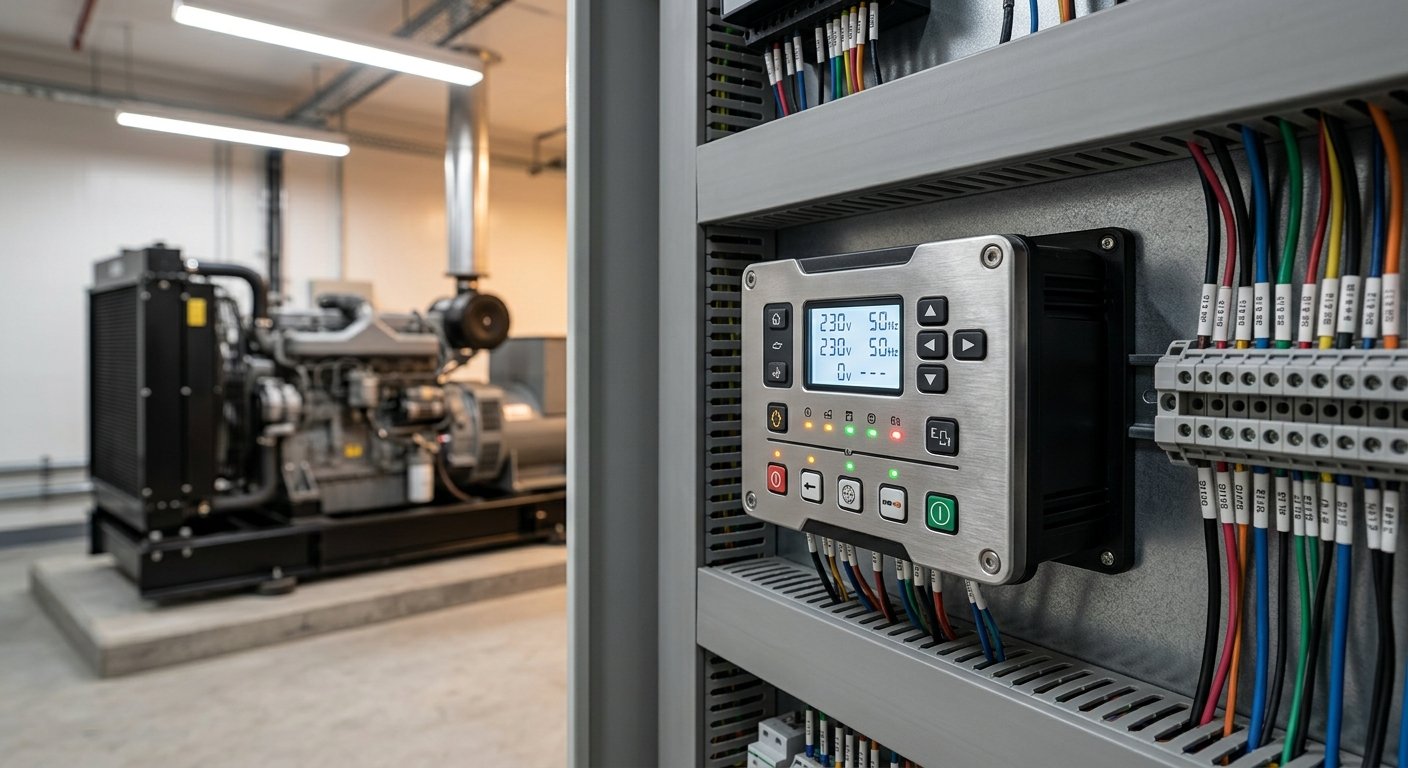
- Digital Control Panels: User-friendly LCD displays provide critical information like status, diagnostics, and maintenance alerts. Our McPherson Controls line offers advanced programmable displays and switch mechanisms for customized control and safety.
These features ensure your commercial standby generator is an intelligent, integrated solution for business continuity.
Top Brands and Popular Models on the Market
The market for commercial standby generators is robust, with several leading manufacturers offering a wide range of reliable and efficient solutions. At MTS Power Products, we work with premier brands that have a proven track record of performance and durability. Some of the most recognized names in the industry include Generac, Cummins, and Kohler.
These manufacturers offer diverse product lines designed to meet the varying power demands of commercial applications, from small businesses to large industrial facilities. Shop Standby Commercial Generators to see a wide array of options.
- Generac Protector Series: Generac has been a leader in standby power for over 50 years. Their Protector Series offers liquid-cooled automatic standby generators designed for commercial use, ranging from 22kW up to 150kW+. Many models feature WiFi connectivity for remote monitoring and are built with purpose-built engines for generator use, requiring less maintenance.
- Cummins Centum Series: Cummins generators are known for powering a wide variety of commercial applications, including retail buildings, warehouse spaces, and grocery stores. Their Centum Series is a new platform designed to meet growing power demands with higher-efficiency engines. Cummins offers specific models like the QSJ5.9G (spark-ignited gas) and QSK23 (diesel-fueled), emphasizing reliable, efficient, and versatile power solutions.
- Kohler Commercial Generators: Kohler offers a strong lineup of emergency standby power generators suitable for commercial applications. These units are available in various kW ratings and configurations, including single-phase and three-phase options, to match diverse business needs.
Exploring Kohler Generator Options
Kohler is a trusted name in the generator industry, providing robust and dependable solutions for commercial backup power. Their commercial generator models are designed for durability and performance, ensuring that your business in Miami has continuous power when it needs it most.
Here are a few examples of Kohler’s offerings, showcasing their range and capabilities:
Kohler also offers models with block heaters, which are beneficial in colder climates to ensure easier starts, though less critical in Miami’s warm weather. Furthermore, they provide options for both single-phase and three-phase power, ensuring compatibility with various commercial electrical systems. Whether your facility runs on single-phase power for lighting and standard appliances or requires three-phase for heavy machinery and industrial equipment, there’s a Kohler solution to fit your specific requirements.
Installation, Costs, and Long-Term Care
After selecting your commercial standby generator, the next steps are professional installation, understanding costs, and committing to long-term maintenance. These phases are crucial for ensuring your generator operates reliably. Choosing an authorized dealer like us provides certified, factory-trained technicians who ensure your investment is protected through proper installation and service.
The Installation Process from Start to Finish
Installing a commercial standby generator is a complex process that demands expertise and adherence to strict safety standards. It is not a DIY project. Here’s an overview of the steps:
- Site Selection: Our certified technicians help you choose the optimal location, considering proximity to utilities, noise ordinances, ventilation, and maintenance access. In Miami, we also factor in flood zones and hurricane preparedness.
- Concrete Pad Preparation: A stable, level concrete pad is required to support the generator’s weight, ensuring it remains secure and functions correctly.
- Local Permits: We handle all necessary permitting with Miami, FL authorities to ensure compliance with local codes and regulations before work begins.
- Electrical Wiring: A licensed electrician wires the generator into your facility’s electrical system via an Automatic Transfer Switch (ATS), ensuring safety and proper function.
- Fuel Line Connection: The fuel system is connected based on your chosen fuel. This involves tapping a utility line for natural gas or installing tanks for propane or diesel.
- System Testing: After installation, we conduct thorough testing, including starting the generator, checking all electrical outputs, and verifying the fuel system.
- Simulated Outage: The final step is a simulated outage. We cut utility power to confirm the ATS and generator activate correctly, ensuring your system is ready for a real-world event.
Understanding the Costs: Purchase, Installation, and Financing
The total cost of a commercial standby generator has several components. While home standby generators might cost $8,000-$16,000 installed, commercial units are typically more expensive due to their larger size and more complex installation.
Here’s a breakdown:
- Generator Unit Cost: The unit price varies by size. Commercial models can range from around $15,000 for a 22kW unit to $46,000 or more for a 150kW model.
- Installation Labor: Certified technicians perform significant labor, including site prep, concrete work, wiring, fuel line installation, and testing.
- Transfer Switch Price: The Automatic Transfer Switch (ATS) is a critical component priced separately from the generator.
- Permitting Fees: Local permits and inspections in Miami, FL, incur fees that vary by project scope.
- Ancillary Costs: These can include trenching for fuel lines, electrical upgrades, or specialized equipment like cranes for large installations.
The upfront investment is substantial, but financing options are available. Commercial financing varies by project cost and credit. We can help you find a plan to make this critical investment manageable.
Essential Maintenance for Your Commercial Standby Generator
A commercial standby generator requires regular maintenance to ensure reliability. Neglecting its care can lead to costly breakdowns and failure during an outage.
Essential maintenance includes:
- Scheduled Maintenance Plans: We offer custom maintenance plans with regular inspections and service intervals based on your generator’s model and usage.
- Weekly Self-Tests: Modern generators perform automatic weekly self-tests to verify readiness. We ensure these are properly configured and monitored.
- Annual Service: A crucial annual service by a certified technician includes oil and filter changes, battery checks, coolant level checks, and inspection of spark plugs, air filters, belts, and hoses.
- Load Banking: A periodic load bank test is recommended for generators that rarely run under heavy load. It connects an artificial load to ensure the generator can produce its full rated power, which exercises the engine and burns off carbon buildup.
Regular maintenance ensures your commercial standby generator is always ready to perform.
Navigating Regulations and Emissions Compliance
Installing and operating a commercial standby generator in Miami, FL, involves navigating various regulations to protect the environment and public safety.
- EPA Tier Ratings: Generators must meet EPA emissions standards, categorized by Tier ratings (e.g., Tier 4F for clean diesel). These dictate acceptable pollutant levels. Businesses in Miami, FL, must adhere to all state and local environmental guidelines.
- Local Noise Ordinances: Miami municipalities have noise ordinances dictating acceptable decibel levels. Sound-attenuated enclosures help meet these requirements.
- Permitting Requirements: Obtaining permits from local building and fire departments is mandatory to ensure your installation meets all safety, electrical, and environmental codes.
- Fuel Storage Regulations: On-site storage of diesel or propane is subject to fire safety and environmental regulations, a key concern in Florida due to hurricane risks.
We stay up-to-date on all local and state regulations applicable to Miami, FL, ensuring your commercial standby generator installation and operation are fully compliant.
Conclusion: Secure Your Business’s Future with the Right Power Solution
A commercial standby generator is a strategic investment in your business’s future. It builds operational resilience, protects assets, and safeguards your reputation. The benefits—from preventing lost revenue to ensuring safety and customer trust—are clear and compelling. This guide has covered calculating ROI, sizing, fuel types, installation, maintenance, and complying with local regulations in Miami, FL.
Choosing the right partner for your commercial standby generator needs is paramount. As a Miami, FL-based manufacturer and provider, MTS Power Products is your direct source for professional-quality generator sets, transfer switches, and electrical products. We pride ourselves on offering custom generators, transfer switches, and our own line of advanced McPherson Controls with programmable displays and high safety standards. Our central location near the Miami International Airport and the Port of Miami allows us to offer worldwide delivery, making us an ideal choice for businesses in South Florida and beyond.
Don’t let the next power outage catch your business off guard. Secure your operations, protect your bottom line, and gain a competitive edge with a reliable commercial standby generator. We are here to provide the expertise, quality products, and exceptional service you need to ensure uninterrupted power for your business.
Commercial Generators Miami – Florida Power House
Explore our full range of commercial backup generators and custom solutions