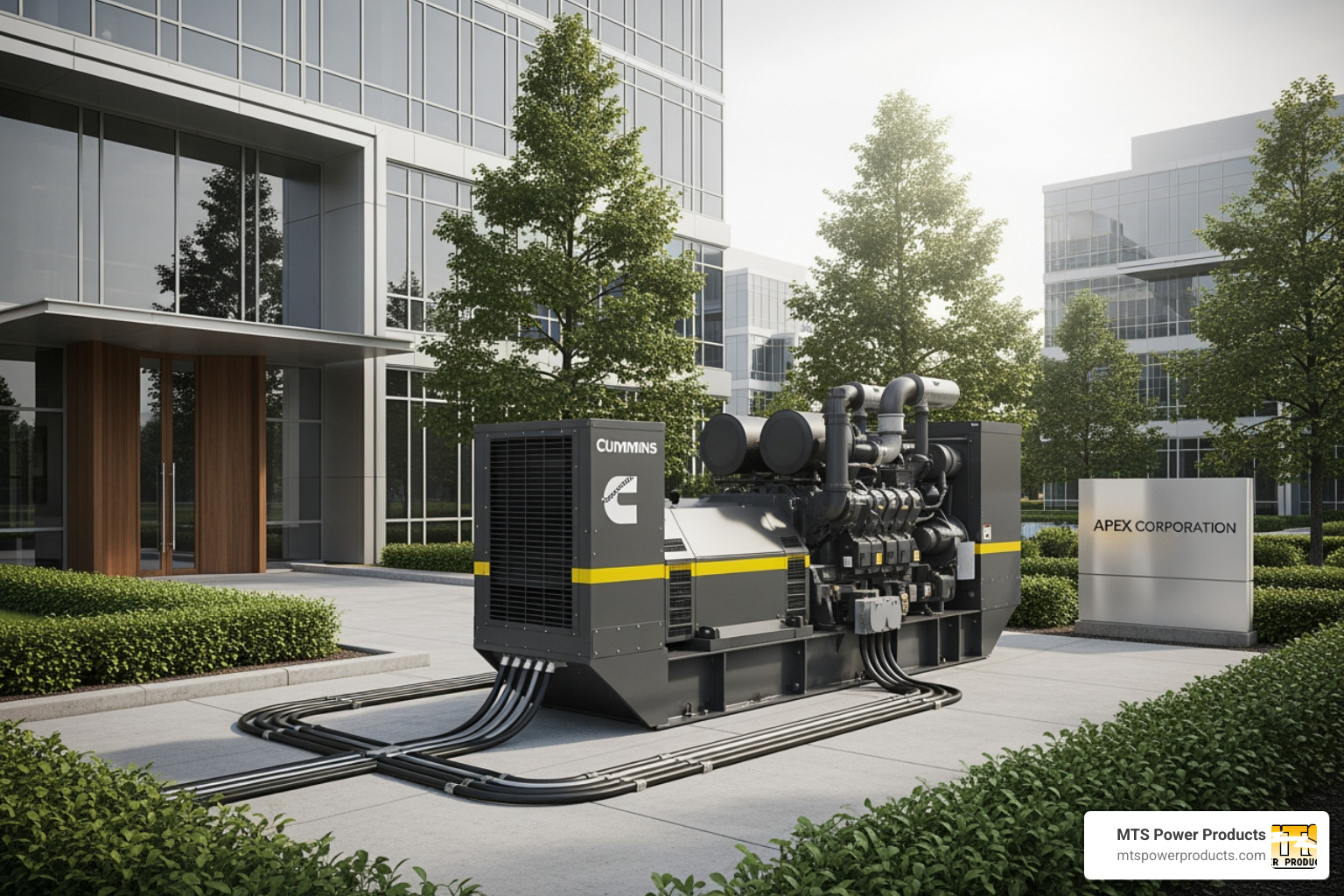



A generator changeover switch automatic (also called an Automatic Transfer Switch or ATS) is a device that automatically switches your power supply from utility power to generator power when it detects an outage, then switches back when utility power returns. Here’s what you need to know:
How it works:
Key benefits:
Imagine waking up at 2 AM during a storm. Your lights are on, your refrigerator is humming, and your HVAC system is running normally. You didn’t flip a single switch or venture outside in the rain to start your generator. That’s the magic of an automatic transfer switch.
Without an ATS, you’d need to manually start your generator, then physically switch your home’s power source using a manual transfer switch. This means stumbling through the dark, risking exposure to the elements, and leaving your home vulnerable if you’re not there when the power fails. For both homeowners and facilities managers, an automatic switch provides peace of mind, ensuring safety and continuous power whether you are home, at work, or away.
The automatic transfer switch sits between your utility power, your generator, and your electrical panel. According to industry standards, these devices are governed by dedicated control logic and are designed to ensure continuous delivery of electrical power from one of two sources to your connected loads.

Key terms for generator changeover switch automatic:
At its core, a generator changeover switch automatic, often referred to as an Automatic Transfer Switch (ATS), is a self-acting, intelligent power switching device. Its main purpose is to ensure the continuous delivery of electrical power from one of two power sources to your connected electrical loads. Think of it as the ultimate power traffic cop, always on duty, constantly monitoring your primary power source (the utility grid) and standing ready to reroute power from your secondary source (your generator) at a moment’s notice.
The magic truly happens in how it works. An ATS continuously monitors the voltage and frequency of your utility power. If it detects that the utility power drops below a certain threshold or fails completely—perhaps due to a storm, grid overload, or an unfortunate squirrel incident—it springs into action. The ATS’s dedicated control logic, typically microprocessor-based, immediately signals your generator to start.
Once your generator is running smoothly and producing stable power, the ATS orchestrates a seamless transfer. It first disconnects your home or facility from the unreliable utility grid, then swiftly connects your electrical loads to the generator. When utility power is restored and stabilized, the ATS performs the reverse operation: it disconnects from the generator and reconnects to the utility, allowing your generator to cool down and shut off. This entire sequence happens automatically, without you lifting a finger.

A generator changeover switch automatic is a sophisticated piece of equipment, comprising several critical components that work in harmony:
Switching Mechanism: This is the physical hardware responsible for connecting and disconnecting electrical loads from power sources. Common types include:
Control Logic/Microprocessor Controller: This is the “brain” of the ATS. It’s a microprocessor-based system that constantly monitors utility and generator parameters (like voltage and frequency). It makes the intelligent decisions about when to initiate a transfer, signal the generator, and restore utility power. Our McPherson Controls line features advanced programmable displays and intelligence for improved control and safety.
Generator Controller Integration: For a truly automatic experience, the ATS and your generator’s controller work hand-in-hand. The generator’s controller often handles all the timing, sensing, exercising functions, and transfer commands, communicating directly with the ATS.
Enclosure: This protective housing shields the internal components from environmental factors. For installations in South Florida, NEMA 3R enclosures are standard for both indoor and outdoor use. These enclosures are designed to protect against falling rain, sleet, and are undamaged by ice formation, ensuring durability in diverse weather conditions.
While the ultimate goal of a generator changeover switch automatic is hands-free operation, these versatile devices offer different modes to suit various needs and scenarios:
Automatic Mode: This is the default and most desirable mode. In automatic mode, the ATS’s controller self-acts, constantly monitoring power sources and managing the entire transfer sequence—from generator startup to shutdown—without any human intervention. This is ideal for ensuring continuous uptime, especially when you’re away or asleep.
Non-Automatic Mode: Sometimes referred to as remote manual, this mode allows for transfer operations to be initiated by a local or remote button or switch. While not fully automated, it still offers the convenience of initiating a transfer without directly interacting with the transfer switch components.
Manual Operation: For maintenance, testing, or in specific emergency situations, a generator changeover switch automatic can be operated manually. This typically involves turning off both the normal (utility) and standby (generator) power supplies, then using a manual handle or a screwdriver to physically move the switch to the neutral, emergency, or normal position. It’s crucial to follow safety protocols and never attempt manual transfer under load.
Exerciser Function/Scheduled Self-Tests: A key feature for maintaining generator readiness, many ATS units include an exerciser function. This allows you to program regular self-tests for your generator, often weekly, bi-weekly, or monthly, with user-selectable run times (e.g., 5-12 minutes). This ensures your generator is always ready to go when you need it most, preventing unpleasant surprises during an actual outage. Our McPherson Controls offer programmable exercisers for optimal readiness.
Selecting the correct generator changeover switch automatic is paramount to ensuring your backup power system operates efficiently, reliably, and safely. Just as you wouldn’t use a tiny car to haul heavy machinery, you wouldn’t pair an undersized ATS with a powerful generator. The choice depends heavily on your specific application, whether it’s a cozy Miami home or a busy industrial plant.

For residential use, a smaller, often single-phase ATS might suffice, managing essential loads like your air conditioner and refrigerator. For commercial buildings or industrial facilities, especially those in our South Florida climate that demand continuous operation, a larger, three-phase ATS with advanced features is usually required. Our team understands the unique demands of both residential and commercial applications in our region and can guide you to the perfect fit.
When diving into the specifics of selecting a generator changeover switch automatic, several technical specifications demand your attention:
Amperage Rating: This defines the maximum current the switch can safely handle. ATS units are available in a wide range, from 40 Amps for smaller residential needs up to 1600 Amps or more for large industrial applications. For instance, many residential units are in the 100-200 Amp range, while high-amperage industrial models can go up to 1000 Amps or beyond.
Voltage: Matching the voltage of your electrical system is critical. Common configurations include 120/208V, 120/240V, and 277/480V, often in three-phase setups for commercial and industrial use.
Single-Phase vs. Three-Phase: Residential applications typically use single-phase power, while most commercial and industrial facilities operate on three-phase power. It’s crucial to select an ATS that matches your facility’s electrical service.
NEMA Rating: This indicates the type of enclosure and its ability to protect against environmental conditions. For outdoor installations, especially in Miami’s humid and occasionally stormy climate, a NEMA 3R enclosure is a must. It provides excellent protection against falling rain, sleet, and ice formation.
UL 1008 Standard: Always look for ATS units that are listed to UL 1008. This is the safety standard for Automatic Transfer Switches for Use in Emergency Systems, ensuring the device meets rigorous safety requirements.
Withstand and Closing Current Rating (WCCR): This is a critical safety rating, indicating the maximum fault current the switch can withstand without damage. The National Electrical Code (NEC) often requires this rating to be field-marked on the exterior of the transfer equipment, ensuring it can safely handle potential short circuits. We offer solutions with robust WCCR ratings, some exceeding 100kA.
Warranty: A good warranty provides peace of mind. Many quality ATS units come with limited warranties, ranging from 2 to 5 years, with options for extended coverage up to 10 years on some models.
The way a generator changeover switch automatic transfers power is crucial, especially for sensitive electronics or critical operations. There are two primary transition methods:
| Feature | Open Transition (Break-Before-Make) | Closed Transition (Make-Before-Break) |
|---|---|---|
| Power Interruption | Momentary break (milliseconds to seconds) | No interruption (continuous power) |
| Complexity | Simpler, less complex | More complex, requires precise synchronization |
| Cost | Generally lower | Generally higher |
| Typical Use Case | Most residential, many commercial (non-critical loads) | Data centers, hospitals, critical industrial processes |
| Safety Considerations | Inherently safe (isolates sources) | Requires precise synchronization to prevent backfeed |
Open Transition (Break-Before-Make): This is the most common type. When utility power fails, the switch breaks the connection to the utility before making the connection to the generator. This creates a brief interruption in power—a momentary blackout—which typically lasts from milliseconds to a few seconds. For most homes and many businesses, this brief interruption is perfectly acceptable. Our solutions often feature rapid transfer times, with some models completing the switch in as little as 160 milliseconds for three-phase systems.
Closed Transition (Make-Before-Break): For critical applications where even a momentary power interruption is unacceptable, closed transition ATS units are used. These switches make a connection to the generator first, then break the connection to the utility, ensuring continuous power to downstream loads. This requires precise synchronization between the two power sources and is a more complex and typically more expensive solution. Total transfer times for these systems can range from 2 to 6 seconds, including the synchronization process.
Understanding the difference between service entrance and non-service entrance rated generator changeover switch automatic is vital for proper installation and compliance with electrical codes.
Service Entrance Rated: These ATS units are designed to be installed at the point where utility power enters your building, making them the first disconnect after the utility meter. They incorporate a main circuit breaker, allowing them to serve as the main service disconnect for your entire home or facility. This means the ATS can provide whole-house protection, transferring all connected loads to the generator during an outage. Service entrance switches are crucial for ensuring that critical loads can shift to emergency power if utility power is interrupted.
Non-Service Entrance Rated: These switches are installed after the main service panel, typically feeding a sub-panel that contains only the essential circuits you want to back up. They do not contain a main circuit breaker and are not intended to be the primary service disconnect. This setup is common for residential applications where homeowners only want to power a select few critical appliances during an outage, rather than the entire house.
Our team in Miami can help you determine whether a service entrance or non-service entrance rated ATS is appropriate for your specific needs, ensuring compliance with local codes and optimal performance.
The primary function of a generator changeover switch automatic extends far beyond mere convenience; it is a critical safety device. Its robust design and intelligent operation are engineered to protect both your property and, more importantly, human lives.
The most crucial safety role of an ATS is to prevent electrical backfeed. Imagine this: the utility power goes out, and your generator kicks on. Without an ATS, there’s a dangerous possibility that the power from your generator could flow back into the utility grid. This poses a severe, potentially lethal, electrocution risk to utility workers who might be repairing lines, believing them to be de-energized.
Electrical codes universally require transfer switches in all standby electric system installations precisely to prevent this dangerous feedback between power sources. Our ATS units incorporate robust, double-throw switch construction with inherent interlocks. These features ensure that the utility and generator power sources are always electrically isolated from each other, making it impossible for them to be connected simultaneously. This physically prevents backfeed, safeguarding both your property and the lives of utility personnel. The contacts are typically electrically operated and mechanically held, ensuring fast, positive connections that resist welding or sticking, even under fault conditions.
For readers who want to dive deeper into the broader safety context around standby power systems and electrical installations, the National Electrical Code offers an overview of widely adopted safety standards in the United States.
For homeowners in South Florida, where power outages due to tropical storms and hurricanes are a common concern, a generator changeover switch automatic is an invaluable asset.
Beyond residential comfort, the generator changeover switch automatic is a cornerstone of reliability in critical facilities that require continuous or near-continuous uptime. These include:
For such demanding environments, sophisticated ATS arrangements, sometimes involving three power sources (e.g., Utility-Generator-Generator for improved redundancy), are employed to guarantee an uninterrupted power supply. For a broader view of how redundant architectures are implemented in mission-critical environments like data centers, you can also review this white paper on data center power distribution.
The evolution of the generator changeover switch automatic has brought forth increasingly sophisticated features, changing it from a simple switching device into a smart power management hub. Our McPherson Controls line exemplifies this evolution, offering advanced functionalities that improve both performance and user experience.
Modern ATS controllers are microprocessor-based, providing immense flexibility for programming set points, displaying real-time information, and logging historical events. This level of intelligence is crucial for optimizing your backup power system.
One of the most significant advancements in ATS technology is the integration of smart power management features, designed to prevent generator overload and maximize efficiency.
Load Management and Load Shedding: Generators, especially residential models, have finite power output. During an outage, you might not need to power every single appliance. Load management systems, often integrated into the ATS, intelligently monitor the generator’s load. If the generator approaches an overload condition (indicated by a drop in generator frequency, for example, below 58 Hz for three seconds), the system begins to “shed” loads. This means temporarily disabling non-essential appliances to prevent the generator from being overwhelmed.
Smart A/C Modules (SACM): For homes in South Florida, where air conditioning is often the largest power consumer, SACMs are a game-changer. These modules can manage multiple individual HVAC loads (typically up to four) without requiring additional hardware. They shed air conditioners in a prioritized sequence, ensuring that your generator can handle the remaining essential loads. When combined with Smart Management Modules, up to eight or more additional loads can be managed, allowing for truly customized power prioritization during an outage.
Our McPherson Controls line of ATS units embodies the cutting edge of advanced controllers and connectivity, bringing unparalleled control and monitoring capabilities directly to your fingertips.
Programmable Controllers and LCD Displays: Modern ATS units feature intuitive, programmable controllers with LCD displays. These displays provide real-time status updates, allowing you to monitor utility and generator power availability, transfer status, and system diagnostics. This improved control means you can customize settings to suit your specific needs.
Time-Stamped Event Logs: To aid in diagnostics and maintenance, advanced controllers keep detailed, time-stamped event logs. These logs record every power event, transfer, and any detected anomalies, providing valuable insights for troubleshooting and system optimization.
Remote Monitoring Capabilities: Imagine being able to check the status of your generator and ATS from your smartphone, whether you’re at work, on vacation, or simply in another room. Many advanced ATS units offer remote monitoring capabilities, often through cloud-based apps or communication protocols like Modbus RTU. This allows you to receive alerts, monitor performance, and even initiate tests remotely, providing ultimate peace of mind. Our McPherson Controls are designed with these advanced connectivity features in mind, allowing for easy integration and monitoring.
While a generator changeover switch automatic is designed for reliability, like any complex electrical system, occasional issues can arise. Knowing some common troubleshooting steps can help resolve minor problems or guide you when to call in the experts.
Switch Fails to Transfer:
Generator Doesn’t Start:
Importance of Qualified Technicians: While basic checks can be helpful, it’s crucial to remember that extremely high and dangerous voltages are present within an ATS. Any work beyond simple visual inspection or fuse replacement should only be performed by competent, qualified personnel. For complex issues, it’s always best to contact a factory-trained technician or your local service provider. Attempting repairs yourself can lead to serious injury or damage to the equipment.
The generator changeover switch automatic is truly a generator’s best friend, changing a backup power system from a manual chore into a seamless, reliable safeguard. We’ve explored how these intelligent devices work, their essential components, various modes of operation, and the critical specifications—like amperage, voltage, and NEMA ratings—that ensure you choose the right one for your specific needs.
We’ve highlighted the paramount role of the ATS in safety, preventing dangerous electrical backfeed and protecting utility workers. For homes in Miami, especially during hurricane season, the convenience, safety, and peace of mind offered by an automatic transfer switch are invaluable. In critical facilities like data centers and hospitals, an ATS is not just a convenience, but a necessity for continuous operation and safety.
Furthermore, we digd into the advanced features that improve modern ATS units, including smart power management for preventing generator overload and cutting-edge controllers with remote monitoring capabilities. Our own McPherson Controls line exemplifies this commitment to advanced, user-friendly technology, offering programmable displays and high safety standards.
At MTS Power Products, located conveniently in Miami, Florida, we understand the unique power needs of our community. We are not just manufacturers and providers; we are your direct source for professional-quality generators, control panels, and, of course, automatic transfer switches. Our expertise allows us to provide custom solutions custom to your residential or commercial requirements.
Don’t let the next power outage leave you in the dark or scrambling for solutions. Invest in the magic of automatic changeover and experience the comfort, safety, and reliability it brings. There is no better company in South Florida to provide custom generators, transfer switches, and more, all backed by our commitment to quality and service.
Find the perfect automatic transfer switch for your generator.