Why Your Generator Needs a Double Throw Switch
A double throw switch for generator applications is a manual transfer switch that allows you to safely switch your electrical system between utility power and generator power. It features three positions—UTILITY, OFF, and GENERATOR—and includes a critical “break-before-make” mechanism that prevents both power sources from connecting simultaneously.
Quick Answer: Selecting a Generator Transfer Switch
When choosing a double throw switch for your generator, you need to determine:
- Pole Configuration: 2-pole for non-separately derived systems (floating neutral generators) or 3-pole for separately derived systems (bonded neutral generators)
- Amperage Rating: Must match or exceed your generator’s output and your service disconnect rating
- Enclosure Type: NEMA 1 for indoor installations or NEMA 3R for outdoor/weather-exposed locations
- Application Level: General-duty (up to 400A) for residential use or heavy-duty (up to 1200A) for commercial/industrial applications
If you’ve ever found yourself staring at your home’s electrical panel during a power outage, wondering how to safely connect your generator, you’re not alone. Many homeowners and facilities managers face this exact challenge. The solution isn’t as simple as plugging in extension cords—it requires a proper transfer mechanism that protects both your electrical system and utility workers.
According to research, the market for transfer switches is projected to grow at over 6% annually, driven by increasing demand for reliable backup power solutions. This growth reflects what many South Florida residents like Rebecca already know: hurricanes and severe weather make backup power systems essential, not optional.
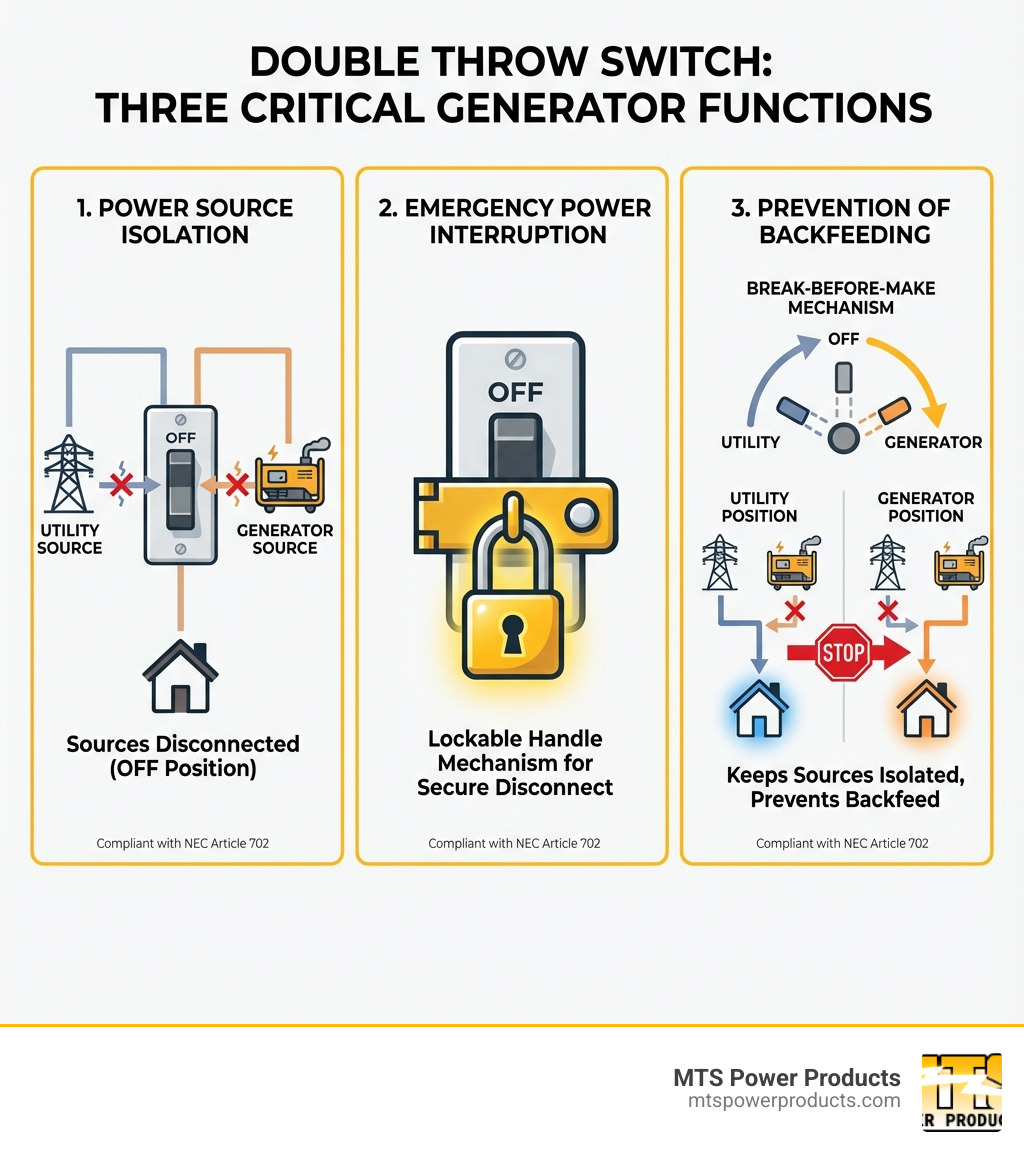
The double throw switch serves three critical roles in your backup power system: it isolates power sources during daily operations, provides a safe way to interrupt power during emergencies, and offers a visible lockout disconnect that complies with Article 702 of the National Electrical Code. These switches ensure that your generator power never backfeeds onto utility lines—a dangerous situation that can electrocute utility workers attempting to restore power.
What is a Double Throw Switch and How Does It Work?
At its heart, a double throw switch is a specialized manual transfer switch designed to manage power flow between two distinct sources: typically your utility grid and your standby generator. Imagine a seesaw for electricity; it can only be tilted one way or the other, or sit perfectly still in the middle. That’s essentially how a double throw switch operates.
This “seesaw” has three distinct positions that are crucial for safe generator operation:
- UTILITY: In this position, your home or business receives power directly from the main utility grid, just as it normally would.
- OFF: This is the critical middle ground. When the switch is in the OFF position, both the utility power and the generator power are completely disconnected from your property’s electrical system. This ensures absolute isolation, which is vital for safety during maintenance or before switching between sources.
- GENERATOR: When the utility power goes out, you’d switch to this position. Your generator’s output is now connected to your property’s electrical panel, providing backup power.
The magic behind this safe transition lies in what’s known as a “break-before-make” mechanism. This design ensures that the connection to one power source is always broken before the connection to the other source is made. This completely prevents any possibility of your generator’s electricity flowing back onto the utility lines, a hazardous condition known as “backfeeding.” This crucial safety feature is why double throw switches are designed to provide optional standby power connections in accordance with Article 702 of the National Electrical Code, ANSI/NFPA 70, and the CEC.
Our McPherson Controls line, for instance, integrates these advanced switch mechanisms for improved control and safety, ensuring that you’re always operating within the safest parameters.
The Core Function: Ensuring a Safe Power Transfer
The primary role of a double throw switch for generator applications is to enable a secure and compliant transfer of electrical load between your primary (utility) power source and your secondary (generator) power source. This isn’t just about convenience; it’s about safeguarding lives and equipment.
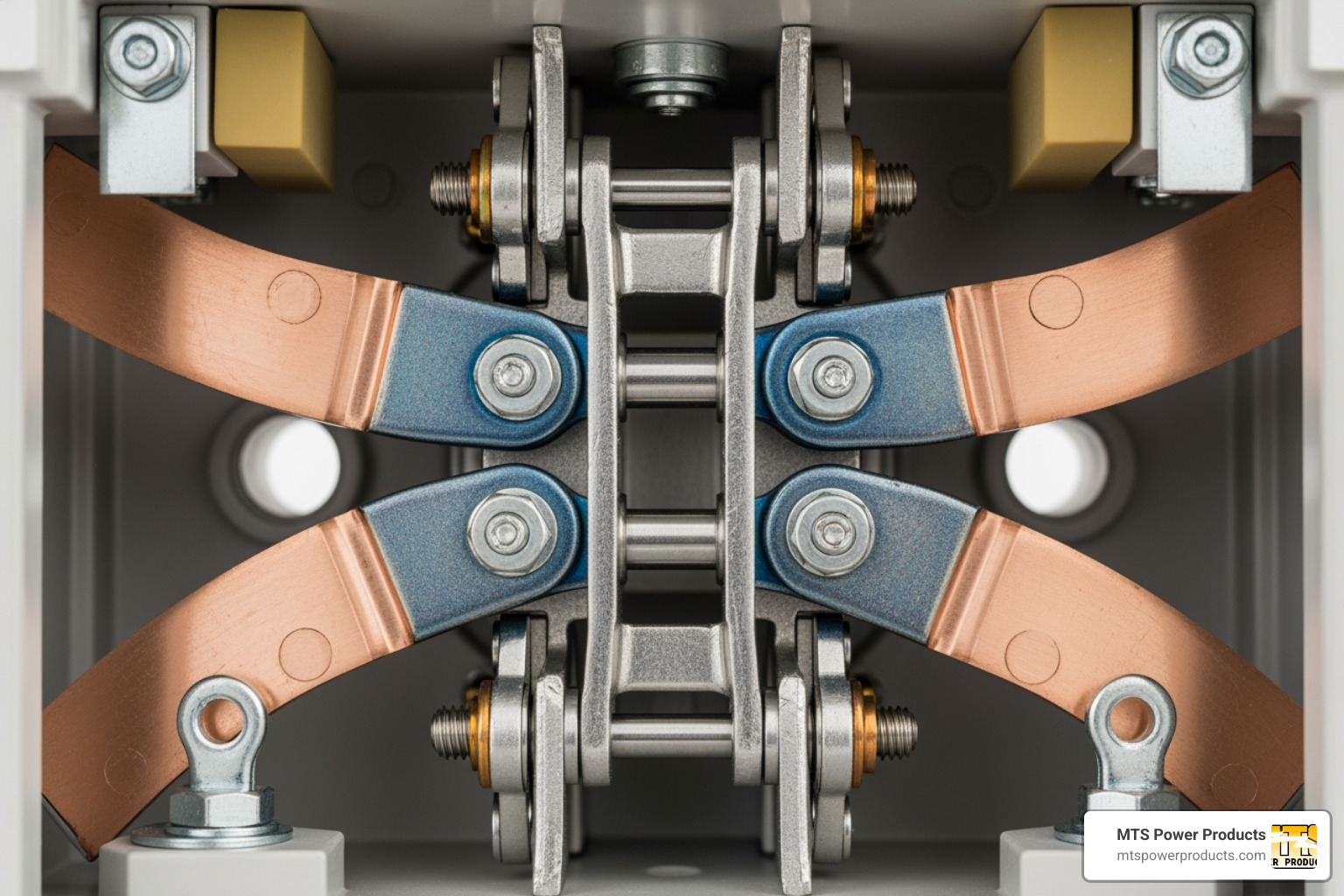
These switches often feature robust components, such as visible blades, which allow you to visually confirm that the electrical contacts are open and that there’s a physical air gap between the live utility lines and your internal wiring. This provides an undeniable level of assurance that power isolation has been achieved. Additionally, many double throw switches come with a lockable handle. This allows you to secure the switch in the OFF position or the GENERATOR position, preventing accidental operation or unauthorized access, especially important during prolonged outages or maintenance.
This capability for clear power isolation and the ability to confidently switch to emergency power is invaluable, particularly in areas like South Florida where power outages can be frequent and extended.
Why Preventing Backfeed is Critical
If there’s one takeaway from understanding a double throw switch for generator, it’s the absolute necessity of preventing backfeed. This isn’t just a technical detail; it’s a matter of life and death, and a legal requirement.
Here’s why backfeeding is such a grave concern:
- Utility Worker Safety: Imagine a utility worker, thinking the power lines are dead, working to restore electricity after a storm. If your generator is backfeeding power onto those lines, they could be electrocuted. This is the single most critical reason for preventing backfeed.
- Protecting Your Generator: When utility power is restored, if your generator is still connected to the grid, it could suffer severe damage from the sudden surge of power. This could range from costly repairs to complete destruction of your generator.
- Preventing Electrical Fires: Uncontrolled power surges and improper connections can overload circuits, overheat wiring, and significantly increase the risk of electrical fires within your property.
- Grid Stability: While less common for a single residential generator, widespread backfeeding could introduce instability into the utility grid, complicating restoration efforts and potentially causing further blackouts.
- Legal Requirements: As mentioned, electrical codes like NEC Article 702 explicitly mandate mechanisms to prevent backfeeding. Non-compliance can lead to fines, invalidate insurance, and open you up to liability in case of an accident.
A double throw switch eliminates these risks by ensuring that your generator power and the utility grid are never connected simultaneously. It’s an essential component for any responsible generator owner.
Choosing the Right Double Throw Switch for Your Generator
Selecting the correct double throw switch for generator use is paramount for safety, efficiency, and compliance. It’s not a one-size-fits-all situation; several factors must align with your specific generator, electrical system, and local codes in Miami, FL.
2-Pole vs. 3-Pole: The Switched Neutral Explained
One of the most critical decisions when choosing a double throw switch is whether you need a 2-pole or a 3-pole configuration. This choice hinges on how your generator’s neutral conductor is handled—specifically, whether it’s a “separately derived system” or a “non-separately derived system.”
- Separately Derived Systems (Requires 3-Pole Switch with Switched Neutral): A generator is considered a separately derived system if its neutral conductor is bonded (connected) to a grounding electrode system at the generator itself. In this setup, the generator creates its own neutral-to-ground bond, independent of the utility’s. To prevent conflicting neutral-to-ground bonds when the generator is running (which can create dangerous current paths), the double throw switch must switch all current-carrying conductors, including the neutral. This means you need a 3-pole switch where all three poles (two hot wires and the neutral) are switched. As per research, a switched neutral is required when the generator neutral is bonded to a grounding system at the generator, avoiding potential backfeeding if the safety switch neutral is also bonded.
- Non-Separately Derived Systems (Often Uses 2-Pole Switch with Solid Neutral): If your generator does not have its neutral bonded to its frame or to a grounding electrode system (often called a “floating neutral” generator), it’s considered a non-separately derived system. In this scenario, the generator relies on the existing neutral-to-ground bond within your main service panel. For these systems, a 2-pole double throw switch is often sufficient, as the neutral conductor can remain solidly connected to your main panel’s neutral bus, and only the two hot conductors are switched.
It is crucial to check your generator’s specifications and consult with a qualified electrician to determine if your generator is a separately derived or non-separately derived system. This will dictate whether you need a 2-pole or 3-pole switch with a switched neutral. For example, a Schneider Electric DTU322 double throw safety switch is a 3-pole switch, suitable for applications requiring a switched neutral.
Key Specifications to Match Your System
Beyond the pole configuration, several other specifications are critical to ensure your double throw switch for generator is correctly matched to your setup:
- Amperage Rating: This is arguably the most important rating. The switch’s amperage rating must be equal to or greater than the maximum output of your generator and the main breaker or service disconnect rating of the circuits it will feed. For instance, if you have a 10kW generator, which might produce around 40 amps, you’d need a switch rated for at least 40 amps, often stepping up to 60 amps for safety and future expansion. Eaton offers heavy-duty double-throw safety switches in a wide range from 30A to 1200A, accommodating various needs.
- Voltage Rating: Ensure the switch’s voltage rating matches your electrical system (e.g., 120/240V AC for most residential applications in South Florida). Some switches, like the Schneider DTU322, are rated for both AC (240V AC) and DC (250V DC).
- Enclosure Type: Where will your switch be installed?
- NEMA 1 (Indoor): If the switch is inside a dry, clean environment, a NEMA 1 enclosure is typically sufficient.
- NEMA 3R (Outdoor): For outdoor installations, such as next to a meter base, or in damp environments, a NEMA 3R enclosure is necessary. This rating provides protection against falling rain, sleet, snow, and external ice formation. RONK switches, for example, are available with NEMA 3R enclosures, suitable for outdoor use.
- Other NEMA ratings like 4, 4X, or 12 offer higher levels of protection against dust, water jets, or corrosion for more demanding industrial environments.
- Fusible vs. Non-Fusible:
- Fusible Switches: These switches incorporate fuses that provide overcurrent protection for the circuits they control. They offer an additional layer of safety by automatically disconnecting power if a fault or overload occurs.
- Non-Fusible Switches: These switches primarily provide a means of disconnection without integrated overcurrent protection. If you opt for a non-fusible switch, you must ensure that adequate overcurrent protection is provided elsewhere in your electrical system, typically upstream, as required by NEC.
General-Duty vs. Heavy-Duty Switches
The distinction between general-duty and heavy-duty double throw switches largely comes down to their construction, durability, and intended application. Choosing the right one ensures longevity and reliable performance for your double throw switch for generator.
Here’s a comparison:
| Feature |
General-Duty Double Throw Switch |
Heavy-Duty Double Throw Switch |
| Amperage Range |
Typically up to 400A (e.g., Eaton’s general-duty switches) |
30A to 1200A (e.g., Eaton’s heavy-duty switches), sometimes higher |
| Typical Application |
Residential, agricultural, light commercial, smaller generators |
Commercial, industrial, larger generators, critical applications |
| Construction |
Designed for standard use, robust but less extreme conditions |
Built for demanding environments, higher fault current ratings |
| Enclosure Materials |
Often painted steel (NEMA 1, 3R) |
Galvanized steel, stainless steel (NEMA 3R, 4, 4X) |
| Cost |
Generally lower |
Generally higher, reflecting improved durability and features |
For most residential applications in South Florida, a general-duty switch up to 200A or 400A might suffice, depending on your home’s service size and generator output. However, for larger estates, commercial properties, or industrial facilities, a heavy-duty switch is often necessary to handle higher amperages and ensure maximum reliability under strenuous conditions. Our McPherson Controls line offers options suitable for both residential and commercial needs, designed to withstand the rigorous demands of power management.
Double Throw Switch vs. Other Transfer Methods
While a double throw switch for generator is a highly effective and safe method for power transfer, it’s not the only option. Understanding its advantages and disadvantages relative to other common methods can help you make an informed decision for your South Florida property.
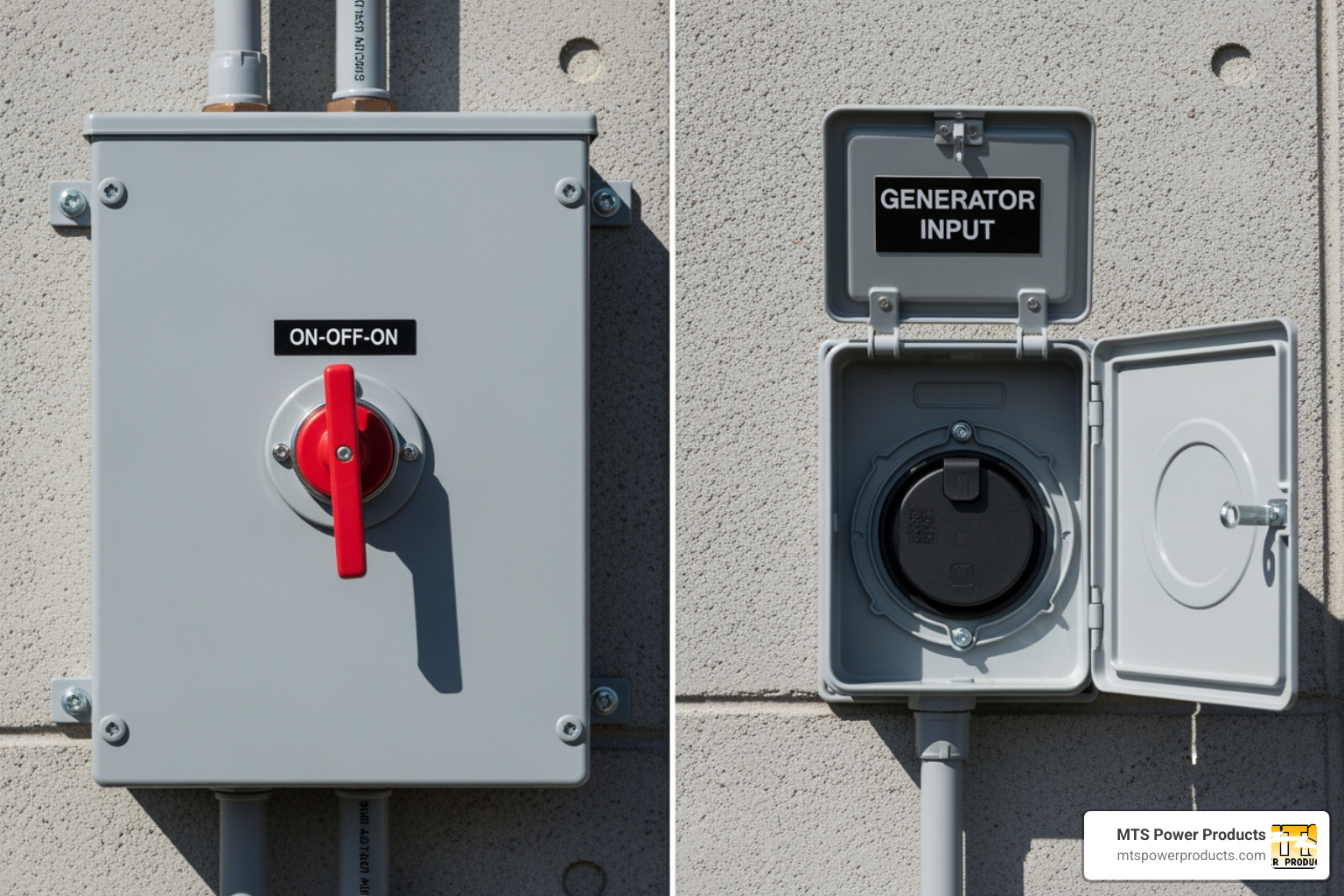
Double Throw Switch vs. Interlock Kits
Interlock kits are a popular alternative, especially for smaller residential setups. An interlock kit is a mechanical device installed in your main electrical panel that physically prevents your main utility breaker and your generator’s breaker from being “ON” at the same time. This achieves the same safety goal of preventing backfeed as a double throw switch.
- Cost Comparison: Forum discussions among electricians suggest that an interlock kit can be significantly cheaper than a double throw switch, potentially saving hundreds of dollars on the part itself.
- Installation Complexity: Installing an interlock kit typically involves modifying your existing main panel. While still requiring a licensed electrician, the labor cost might be lower compared to installing a separate, external double throw switch, which can involve more extensive wiring and conduit work.
- Functionality Differences:
- Double Throw Switch: A dedicated, often external, switch that completely isolates power sources. It’s a clear, visible point of transfer. It can be installed as the first disconnect next to a meter base, serving as the main service disconnect if properly configured with a 4-wire feed and separated neutrals/grounds.
- Interlock Kit: Integrates directly into your existing panel, making it a more discreet solution. However, it only allows you to power circuits already present in your main panel. If you need to power a specific set of circuits (e.g., only essential loads), you might still need to manage them by manually turning off non-essential breakers.
- Aesthetics: A double throw switch, especially a large heavy-duty one, is a visible external component. An interlock kit is mostly hidden inside your main breaker panel.
For those in Miami, FL looking for a cost-effective solution for a smaller generator, an interlock kit can be a viable option. However, for larger generators, commercial applications, or if you prefer a dedicated, external transfer point, a double throw switch remains an excellent choice.
Double Throw Switch vs. Extension Cords
This is where safety becomes paramount. While tempting during an outage, relying solely on extension cords to power appliances directly from a generator is fraught with danger and is generally not recommended as a permanent or safe solution.
- Hardwired Appliances: A double throw switch allows you to power hardwired appliances like central air conditioning, well pumps, water heaters, and your entire home’s lighting system. Extension cords can only power individual, portable devices.
- Convenience: With a double throw switch, once power is transferred, your home’s electrical outlets and light switches function normally. No need to run multiple cords, open windows for ventilation, or move appliances.
- Powering Individual Items: Extension cords are limited to powering a few individual items, and you must carefully manage the load to avoid overloading the generator or the cords themselves.
- Setup Time During an Outage: Setting up multiple extension cords can be time-consuming and cumbersome in the dark. A double throw switch provides a swift, single-action transfer.
- Safety: This is the biggest differentiator.
- Fire Hazard: Overloaded extension cords can overheat and cause fires. Improperly routed cords can create tripping hazards.
- Carbon Monoxide Poisoning: Generators must always be operated outdoors in a well-ventilated area, far from windows and doors. Using extension cords to bring power indoors can lead to operating the generator too close to the home, increasing the risk of deadly carbon monoxide poisoning.
- Backfeed Risk: If someone attempts to jury-rig a connection to the main panel using extension cords (a practice sometimes called “suicide cords”), it creates an extremely dangerous backfeed situation.
For reliable, safe, and comprehensive backup power for your entire property, a hardwired solution with a double throw switch for generator is unequivocally superior to using extension cords.
Installation, Safety, and Cost of a Double Throw Switch for Generator
The decision to install a double throw switch for generator is a wise one, but its effectiveness and safety are entirely dependent on proper installation. This is not a DIY project.
Safety and Installation Requirements
Given the inherent risks of working with high-voltage electricity and connecting multiple power sources, professional installation by a licensed electrician is non-negotiable. Here’s why and what’s involved:
- Hiring a Licensed Electrician: Only a qualified, licensed electrician in Miami, FL, understands the intricacies of local electrical codes, wiring requirements, and safety protocols. They ensure your installation is compliant and safe.
- Local Electrical Codes: Electrical codes can vary by municipality, even within South Florida. A professional electrician will be up-to-date on all local requirements, ensuring your installation passes inspection and is legally compliant.
- NEC Article 702 Compliance: As previously mentioned, double throw switches are designed to meet the requirements of NEC Article 702, which covers optional standby power systems. An electrician ensures this compliance.
- Service Disconnect: If the double throw switch is installed next to your meter base and intended to be the first point of disconnection for your entire electrical system, it must be rated as a service disconnect. This has specific requirements for labeling and construction.
- Proper Grounding: A critical safety measure, proper grounding protects against electrical shock and ensures fault currents are safely dissipated. An electrician will ensure correct grounding of both the switch and your generator system.
- 4-Wire Feed: If your double throw switch acts as the first disconnect, your main panel will need to be fed with a four-wire connection (two hot, one neutral, one ground) from the switch.
- Separating Neutrals and Grounds: In a separately derived system (common with larger generators), the neutral and ground conductors must be separated in your main panel downstream of the transfer switch. An electrician will know how to correctly configure this to prevent dangerous ground loops.
- Lockout Procedures: An electrician will ensure the switch supports proper lockout/tagout procedures for maintenance, preventing accidental re-energization.
- Proper Torque Specifications: All electrical connections must be tightened to specific torque specifications to ensure good contact and prevent overheating. Product data sheets, like those for the Schneider DTU322, provide detailed torque values for various wire sizes.
Improper installation can negate all the safety benefits of a double throw switch, creating hazardous conditions. Always trust a professional.
What is the Typical Cost?
The cost of a double throw switch for generator setup can vary significantly based on several factors, including the switch’s amperage, pole configuration, enclosure type, and whether it’s general-duty or heavy-duty.
- Switch Cost Range: Based on product listings, you can find double throw switches ranging from approximately $100 for smaller, basic models up to $1,900+ for large, heavy-duty commercial or industrial units. Our McPherson Controls line offers professional-quality options to suit various budgets and needs.
- Residential vs. Industrial Pricing: Residential switches (typically up to 200A or 400A) will be on the lower end of the spectrum, while industrial-grade switches (up to 1200A or more) designed for demanding environments will naturally be more expensive.
- Installation Labor Costs: This is a significant factor. While the switch itself might be a few hundred dollars, the labor for a professional electrician in Miami, FL, to install it can add substantially to the total cost. Forum discussions among electricians indicate that installing a double throw switch can incur 4-5 times as much labor cost compared to a simpler interlock kit, due to the complexity of external wiring, conduit, and potential modifications to your service entrance.
- Cost vs. Alternative Transfer Methods: As noted, interlock kits are generally less expensive to purchase and install. However, they offer less functionality than a full double throw switch, particularly for whole-home power or larger loads. Portable generator sub-panels, while an older solution, might also be an option for limited circuits at a lower cost, but they lack the modern safety and convenience of a dedicated double throw switch.
- Long-Term Value: While the initial outlay for a double throw switch and professional installation might seem higher, consider the long-term value: improved safety, compliance with codes, convenience during outages, and the protection of your generator and property. In a region prone to power disruptions, this peace of mind is invaluable.
Where to Buy Double Throw Switches
When you’re ready to invest in a double throw switch for generator applications, you have several avenues for purchase, especially in a hub like Miami, FL.
- Electrical Supply Houses: These specialized stores carry a wide range of electrical components, including various types and brands of double throw switches. They can often provide expert advice.
- Specialized Power Equipment Providers: Companies like MTS Power Products specialize in generator sets, transfer switches, and related electrical products. We offer a distinct advantage as a direct source for professional quality equipment, including our own McPherson Controls line. Being centrally located near the Miami International Airport and the Port of Miami, we offer convenience for local customers and worldwide delivery.
- Online Retailers: A quick search will reveal many online platforms selling double throw switches. While convenient, ensure you are purchasing from a reputable vendor and can easily access customer support or warranty services.
- Direct from Manufacturers: Some manufacturers might offer direct sales or have authorized distributors. Our expertise at MTS Power Products allows us to provide custom solutions and guide you through selecting the ideal switch for your needs.
We invite you to explore our full range of generator transfer switches to find the perfect solution for your home or business.
Conclusion: Powering Your Property with Confidence
Investing in a double throw switch for generator power is more than just buying a piece of electrical equipment; it’s investing in the safety, reliability, and peace of mind for your home or business, especially in a hurricane-prone area like South Florida. We’ve seen how this critical component acts as the guardian between your property, your generator, and the utility grid, preventing dangerous backfeed and ensuring smooth power transitions.
We’ve explored the nuances of 2-pole versus 3-pole configurations, emphasizing the importance of a switched neutral for separately derived systems. We’ve also digd into the key specifications—amperage, voltage, and enclosure type—that must precisely match your system’s requirements. The distinction between general-duty and heavy-duty switches ensures that whether you’re powering a small home or a large commercial facility, you have the robust solution you need.
While alternatives like interlock kits exist, and the temporary use of extension cords is sometimes considered, the hardwired safety and comprehensive functionality of a double throw switch remain unparalleled for a truly reliable backup power setup. Professional installation by a licensed electrician is paramount to ensure compliance with NEC Article 702 and local codes, safeguarding lives and property.
At MTS Power Products, we understand the unique power needs of South Florida. Our McPherson Controls line provides advanced, professional-quality power control solutions, and our team is ready to guide you through selecting and implementing the perfect double throw switch for your generator. Don’t compromise on safety or reliability when it comes to backup power.
Explore our full range of generator transfer switches and empower your property with confidence.